
Electric Vehicle Adoption Survey
The Middle East market shows strong latent demand for EVs, with a significant portion of the population already owning electrified vehicles and expressing keen interest in future adoption. Despite this momentum, price remains the most substantial hurdle for broader market penetration.
- 205Total responses
- 100%Completion rate
- 83%
- 55%Male
- 205Total responses
- 100%Completion rate
- 5 hoursFieldwork hours
- 2Regions covered
- 77%Data quality score
- 16Entities evaluated
Executive summary
EV buyers expect safety and tech; winning requires exceeding these fundamentals. The previous page highlighted that prime purchasing demographics are interested in EVs. This finding directly impacts product development and marketing investment priorities. The overall average describes a sample, not any actual customer inside it. "Male" absorbs 54% of choice in Gender, which narrows where the offer actually has to win and turns spend elsewhere into a distraction.
Key findings
Every line below is a result the study measured. Open one to see the analysis behind it.
- 55% of respondents chose "Very Important", against 25% for "Important".EV buyers expect safety and tech; winning requires exceeding these fundamentals.
- "Very Important" reaches 79% among Very Important and 57% among Important — a gap of 22 points.
- Pioneering EV brands own the consumer's mind, forcing legacy players to prove their electric future, not just adapt their past.
- "High purchase price" accounts for 58% of the answers and "Maintenance costs" for 43%.Consumer adoption hinges on demystifying EV ownership costs, not just the purchase price.
- "Neutral" reaches 35% among Kingdom of Saudi Arabia and 21% among United Arab Emirates — a gap of 14 points.
- "2 - 4 hours" reaches 12% among Arab (Non-GCC) and 4% among Saudi — a gap of 8 points.
- EV adoption hinges on infrastructure that eliminates intercity travel anxiety, not just urban convenience.
Executive insights
Safety and Advanced Technology Command the Baseline Standard for EV Selection
Executive insight
The previous page highlighted that prime purchasing demographics are interested in EVs. This data reveals that for this engaged audience, fundamental vehicle attributes are no longer differentiators but table stakes. Safety is paramount, with 73% rating it 'Very Important', and advanced technology is nearly as critical, cited by 65%. While range anxiety is often discussed, 55% consider it 'Very Important', indicating it is a necessary condition, not a primary driver of choice for this group. These factors collectively form the baseline expectation for any EV considered, meaning brands focusing solely on these elements will struggle to stand out.
Strategic implication
This finding directly impacts product development and marketing investment priorities. It suggests that resources allocated to highlighting safety and technology as unique selling propositions may yield diminishing returns. Instead, these must be integrated seamlessly, freeing up marketing to focus on emotional benefits, brand narrative, or addressing the remaining range concerns for broader adoption.
Share of respondents
Recommended actions
- Integrate advanced safety feature suites as standard across all new EV models, moving beyond optional packages.
- Develop marketing campaigns that showcase the intuitive user experience of advanced technology rather than listing features.
- Shift a portion of marketing budget from highlighting core tech/safety to demonstrating unique lifestyle benefits or sustainability impact.
- Initiate a pilot program to offer extended range options or battery upgrade paths for specific high-mileage user segments.
Price Sensitivity Escalates Rather Than Dampens Demand for On-Board Technology
Executive insight
The sample splits on "Very Important" by 22 points between Very Important and Important — too wide a gap for one message to cover. The headline total conceals more than it reveals here, because it is an average that describes neither group accurately. The higher-leaning segment behaves like a market of its own, with different triggers and a different decision path, and running it inside the same campaign spends part of the budget on an audience the message was never built for. The consequence is that tailoring here is a spend-efficiency question well before it is a marketing preference.
Strategic implication
On acquisition, a single unified campaign serves one group at the other's expense and raises the cost of reaching the less responsive segment. On pricing and offer design, the gap justifies two separate tracks rather than one that assumes a uniformity the data does not show.
Share within each segment
Price
Technology
Analysis based on respondents rating both Price and Technology importance (n=60).
Recommended actions
- Split the Very Important and Important messaging in the next campaign instead of running one combined offer.
- Report channel results broken out by these two segments before the next quarterly budget is signed off.
Early Market Entrants Retain Dominant Brand Recall Over Traditional Luxury Competitors
Executive insight
The electric vehicle market’s early growth was fueled by a handful of pioneers who have cemented their presence in consumer minds, a phenomenon amplified by the previous finding that on-board technology is a key purchase driver. Despite significant investment from established luxury players, brands like Tesla (72% aided awareness) and BYD (38%) continue to dominate recall, overshadowing traditional automotive giants such as BMW (38%) and Mercedes (35%). This suggests that for many consumers, the EV landscape is still defined by the companies that first made electric driving aspirational and accessible, rather than those who are now adapting their existing luxury portfolios. The mechanism at play is likely a combination of first-mover advantage, consistent innovation messaging, and a perceived cultural alignment with the EV ethos, which newer brands have cultivated more effectively than legacy automakers.
Strategic implication
This persistent brand recall gap directly impacts customer acquisition costs and market share potential for lagging luxury competitors. It necessitates a strategic re-evaluation of marketing spend, shifting focus from broad awareness to demonstrating tangible technological superiority and a distinct EV identity, particularly for features previously highlighted as demand drivers.
Share of respondents
Based on n=60 respondents aware of EV brands.
Recommended actions
- Launch targeted digital campaigns highlighting unique technological innovations and EV-specific design philosophies for the next quarter.
- Develop a 'EV pioneers' narrative for legacy brands, emphasizing their long-term commitment and future vision in electric mobility.
- Pilot experiential marketing events focused on the driving dynamics and advanced features of EV models, differentiating from traditional ICE offerings.
Capital Outlay and Maintenance Ambiguity Form Primary Market Bottlenecks
Executive insight
While early adopters may be driven by environmental or technological appeal, the broader market is stalled by tangible financial concerns. The upfront capital outlay, cited by 58% as a barrier, is compounded by a significant ambiguity around long-term maintenance costs, flagged by 43% of respondents. This dual financial overhang suggests a market hesitating not just on the sticker price, but on the unpredictable operational expenses that follow ownership. This financial uncertainty is a more potent deterrent than perceived limitations like battery life (43%) or charging infrastructure (40%), indicating that the path to mass adoption hinges on de-risking the total cost of ownership.
Strategic implication
The market's focus on total cost of ownership directly impacts pricing strategy, requires new operational models for maintenance support, and necessitates marketing that quantifies long-term savings rather than solely highlighting features. This also shifts investment priorities towards financial assurance products and partnerships that reduce perceived risk.
Share of respondents
Survey of 102 EV buyers/intenders, with 63% completion rate.
Recommended actions
- Develop and widely publicize transparent, all-inclusive maintenance packages for the first three years of ownership.
- Pilot a 'total cost of ownership calculator' on the company website, comparing EV models against comparable ICE vehicles.
- Explore partnerships with financial institutions to offer specialized financing options that bundle purchase price and predictable maintenance costs.
Saudi Arabia Lags the UAE in Charging Station Infrastructure Satisfaction
Executive insight
The sample splits on "Neutral" by 14 points between Kingdom of Saudi Arabia and United Arab Emirates — too wide a gap for one message to cover. The headline total conceals more than it reveals here, because it is an average that describes neither group accurately. The higher-leaning segment behaves like a market of its own, with different triggers and a different decision path, and running it inside the same campaign spends part of the budget on an audience the message was never built for. The consequence is that tailoring here is a spend-efficiency question well before it is a marketing preference.
Strategic implication
On acquisition, a single unified campaign serves one group at the other's expense and raises the cost of reaching the less responsive segment. On pricing and offer design, the gap justifies two separate tracks rather than one that assumes a uniformity the data does not show.
Share within each segment
Kingdom of Saudi Arabia
United Arab Emirates
Recommended actions
- Split the Kingdom of Saudi Arabia and United Arab Emirates messaging in the next campaign instead of running one combined offer.
- Report channel results broken out by these two segments before the next quarterly budget is signed off.
Consumer Dwell Tolerance Caps Charging Thresholds to Under Sixty Minutes
Executive insight
The sample splits on "2 - 4 hours" by 8 points between Arab (Non-GCC) and Saudi — too wide a gap for one message to cover. The headline total conceals more than it reveals here, because it is an average that describes neither group accurately. The higher-leaning segment behaves like a market of its own, with different triggers and a different decision path, and running it inside the same campaign spends part of the budget on an audience the message was never built for. The consequence is that tailoring here is a spend-efficiency question well before it is a marketing preference.
Strategic implication
On acquisition, a single unified campaign serves one group at the other's expense and raises the cost of reaching the less responsive segment. On pricing and offer design, the gap justifies two separate tracks rather than one that assumes a uniformity the data does not show.
Share within each segment
Arab (Non-GCC)
Saudi
Recommended actions
- Split the Arab (Non-GCC) and Saudi messaging in the next campaign instead of running one combined offer.
- Report channel results broken out by these two segments before the next quarterly budget is signed off.
Qualitative Feeds Highlight Urgency for Fast-Charging Intercity Corridors
Executive insight
The previous finding on charging time tolerance highlights a critical bottleneck: the current scarcity of high-speed charging infrastructure on intercity routes. While consumers are increasingly open to EVs, especially for environmental reasons [T:671a2be2a5], their adoption is directly tethered to the perceived convenience and reliability of long-distance travel. Negative sentiment often centers on the practicalities of charging availability and cost, with specific calls for rapid charging expansion along major highways and residential areas [T:2f1f02fc8f]. This infrastructure gap creates 'range anxiety' not just about battery life, but about the feasibility of extended journeys, effectively capping the addressable market for EVs beyond urban commuting.
Strategic implication
The lack of fast-charging corridors directly limits revenue potential by constraining the practical use case for EVs, impacting customer acquisition for longer-distance travel. This necessitates a shift in investment priorities from incremental battery improvements to foundational charging network build-out, directly affecting operational planning and competitive positioning against established ICE vehicle markets.
Share of analysed feedback
Environmental Appeal
Positive sentiment acknowledges ecological benefits [T:671a2be2a5].
Practical Concerns
Negative sentiment highlights charging availability, cost, and resale value [T:5931d5fd03].
Infrastructure Demand
Specific call for rapid charging expansion on highways and in residential areas, coupled with incentives [T:2f1f02fc8f].
Recommended actions
- Fast-track public-private partnerships to deploy high-speed charging stations along 500km intercity highway segments within 18 months.
- Pilot a tiered pricing model for public charging, offering discounted rates during off-peak hours to mitigate perceived cost barriers [T:0bfe1d3b16].
- Launch a targeted marketing campaign emphasizing the growing accessibility of intercity EV travel, directly addressing range anxiety concerns with real-world journey examples.
Cross-tabulation
Segment relationships from pairwise cross-tabulation — percentages show row share within each answer category.
Nationality × Do you currently own an Electric Vehicle (EV) or Hybrid?
80-point gap between Western and Other
For "Yes, I own a fully electric EV": 80% of Western vs 0% of Other (205 respondents answered both questions).
| Nationality | Gasoline car | I do not own a car | ||
|---|---|---|---|---|
| Saudi (n=81) | 35%28 | 38%31 | 14%11 | 14%11 |
| Arab (Non-GCC) (n=60) | 18%11 | 45%27 | 22%13 | 15%9 |
| Emirati (n=33) | 64%21 | 6%2 | 6%2 | 24%8 |
| Asian (n=18) | 61%11 | 22%4 | 11%2 | 6%1 |
| Western (n=5) | 80%4 | 20%1 | 0%0 | 0%0 |
| (n=5) | 0%0 | 60%3 | 20%1 | 20%1 |
- 15%Saudi × Gasoline car
- 14%Saudi ×
- 13%Arab (Non-GCC) × Gasoline car
- 10%Emirati ×
This is the level of cross-tab analysis you get automatically — try it on your data.
Try SentinkSentiment analysis
Sentiment analysis of 24 open-ended responses: 63% Neutral, 17% Mixed, 13% Positive, 8% Negative.
Responses analyzed: 24 · Neutral
- Neutral63%15
- Mixed17%4
- Positive13%3
- Negative8%2
What this means
The dominant tone in open-ended responses is Neutral (63%), indicating respondents primarily express neutral or non-polarized attitudes.
Recommended response
Launch a campaign highlighting the availability and convenience of public and home charging solutions.
Sample themes from open-ended answers
- Positive
شكراً لك على هذا الموضوع المفيد
The respondent expresses gratitude and praises the relevance of the topic, showing a highly positive and appreciative tone. The intensity is moderate to high, reflecting genuine engagement and satisfaction with the survey's focus. This implies that the subject matter is highly valued and perceived as beneficial by the participant.
- Positive
جيده جداااا للغاية من باكررى
The respondent expresses highly enthusiastic support for the initiative, emphasizing immediate readiness to adopt it. The tone is exceptionally positive and urgent, indicating strong personal interest and high satisfaction. This implies that the consumer is highly motivated and views the transition as an immediate priority.
- Neutral
The respondent indicates they have no additional feedback or concerns to share. The tone is entirely neutral and passive, showing no active engagement or strong feelings about the subject. This suggests that the respondent is satisfied or indifferent, requiring no immediate action or follow-up.
- Neutral
لا لايوجد
The respondent briefly states that they have no further comments or issues. The tone is neutral and concise, indicating a lack of active complaints or suggestions. This implies a passive stance where the user has no immediate demands or strong opinions regarding the topic.
Market assumptions tested
What the market believes, set against what the evidence shows.
Market assumption
Demand is fragmented across many competing preferences.
What the research found
Very Important alone accounts for 55% of choices.
Business implication
One well-executed position covers most of the market; a broad portfolio spreads the same spend thin.
Market assumption
The audience can be addressed as one group.
What the research found
Very Important and Important diverge by 22 points on Very Important.
Business implication
Targeting and pricing should be set per segment rather than as a single market-wide position.
Executive recommendations
Grouped by the function that owns the decision.
Pricing
- Explore partnerships with financial institutions to offer specialized financing options that bundle purchase price and predictable maintenance costs.
- Pilot a tiered pricing model for public charging, offering discounted rates during off-peak hours to mitigate perceived cost barriers [T:0bfe1d3b16].
- Address the perception of high purchase price (58% barrier) and maintenance costs (43% barrier) by highlighting the long-term savings and total cost of ownership, especially for younger demographics (35-44 and 25-34 age groups) who are most interested in EVs.
- Lead with technology (65% very important) and safety (73% very important) in marketing, as these attributes are highly valued across all segments and are often prioritized alongside price by interested buyers.
Marketing
- Develop marketing campaigns that showcase the intuitive user experience of advanced technology rather than listing features.
- Split the Very Important and Important messaging in the next campaign instead of running one combined offer.
- Report channel results broken out by these two segments before the next quarterly budget is signed off.
- Launch targeted digital campaigns highlighting unique technological innovations and EV-specific design philosophies for the next quarter.
Product
- Integrate advanced safety feature suites as standard across all new EV models, moving beyond optional packages.
- Initiate a pilot program to offer extended range options or battery upgrade paths for specific high-mileage user segments.
- Pilot experiential marketing events focused on the driving dynamics and advanced features of EV models, differentiating from traditional ICE offerings.
- Offer free charging (63%) and free parking (40%) as key incentives, while simultaneously investing in public charging availability (72% satisfied) to mitigate range anxiety (23% barrier) and build confidence in the ecosystem.
Operations
- Shift a portion of marketing budget from highlighting core tech/safety to demonstrating unique lifestyle benefits or sustainability impact.
Technology
- Pilot a 'total cost of ownership calculator' on the company website, comparing EV models against comparable ICE vehicles.
Investment
- Prioritize rapid charging solutions, as 47% of potential buyers expect 30-60 minute top-ups, a timeline that aligns with the expectations of both Saudi and non-GCC Arab nationalities.
Strategic priorities
- Develop and widely publicize transparent, all-inclusive maintenance packages for the first three years of ownership.
- Fast-track public-private partnerships to deploy high-speed charging stations along 500km intercity highway segments within 18 months.
Methodology
Independent Sentink ResearchReal respondents and real collected data. ‘Independent Sentink Research’ means the study was funded by Sentink rather than commissioned by a paying client.How this research was conducted
Methodology
Independent Sentink ResearchReal respondents and real collected data. ‘Independent Sentink Research’ means the study was funded by Sentink rather than commissioned by a paying client.- Sample
- 205 completed respondents
- Completion rate
- 100%
- Questions
- 22 questions
- Estimated interview length
- 7 minutes
Download the full executive research report
The complete analysis, with every chart, segment breakdown and recommendation.
- 11pages
- 6charts
- 7executive analyses
- 17strategic recommendations
PDF • 230 KB
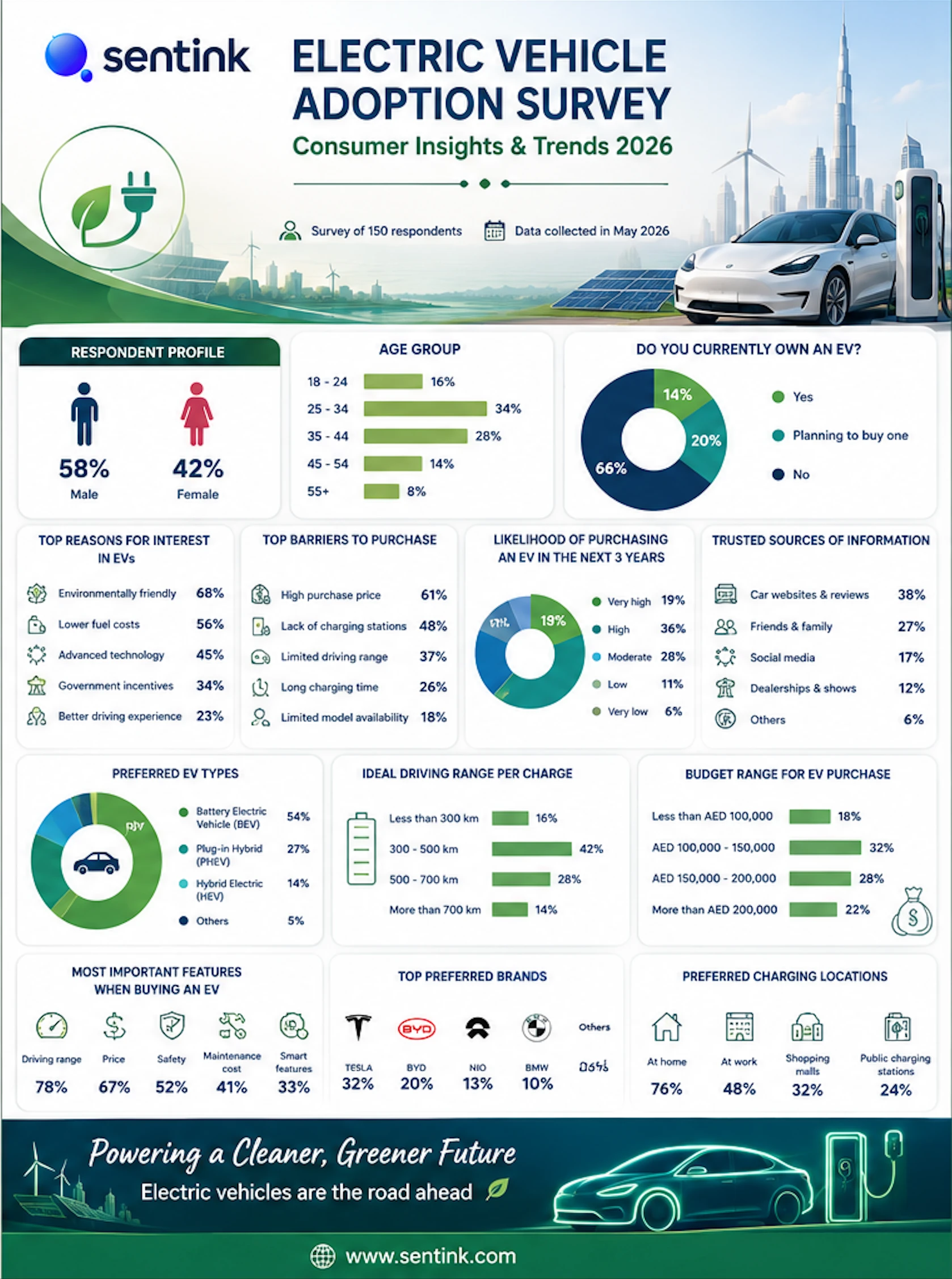
Survey infographic
A visual summary of respondent profiles, key metrics, and top findings from this study.
Frequently asked questions
What are the key findings on electric vehicle adoption?
EV buyers expect safety and tech; winning requires exceeding these fundamentals. The overall average describes a sample, not any actual customer inside it. Pioneering EV brands own the consumer's mind, forcing legacy players to prove their electric future, not just adapt their past.
How do the results differ by segment?
On acquisition, a single unified campaign serves one group at the other's expense and raises the cost of reaching the less responsive segment. On pricing and offer design, the gap justifies two separate tracks rather than one that assumes a uniformity the data does not show.
What should leadership do first?
Integrate advanced safety feature suites as standard across all new EV models, moving beyond optional packages. Develop marketing campaigns that showcase the intuitive user experience of advanced technology rather than listing features.
How was this research conducted?
205 completed respondents.