

MENA Online Trading & Forex Market Study 2026
The MENA online trading market shows strong interest, but conversion from interest to active trading is hampered by significant friction points in the user journey. Addressing these barriers is critical for growth.
- 213Total responses
- 100%Completion rate
- 92%
- 87%
- 213Total responses
- 100%Completion rate
- 6 hoursFieldwork hours
- 4Regions covered
- 79%Data quality score
- 16Entities evaluated
Executive summary
YouTube and Search are the primary drivers for income-seeking investors, with Gold as the preferred asset for wealth generation. The pursuit of wealth generation and income is increasingly channeled through digital platforms, with YouTube and Google Search emerging as the primary gateways for MENA investors. This finding directly impacts customer acquisition and marketing strategy by highlighting dominant digital discovery channels. "Binance" settles the decision before the customer ever reaches a price comparison.
Key findings
Every line below is a result the study measured. Open one to see the analysis behind it.
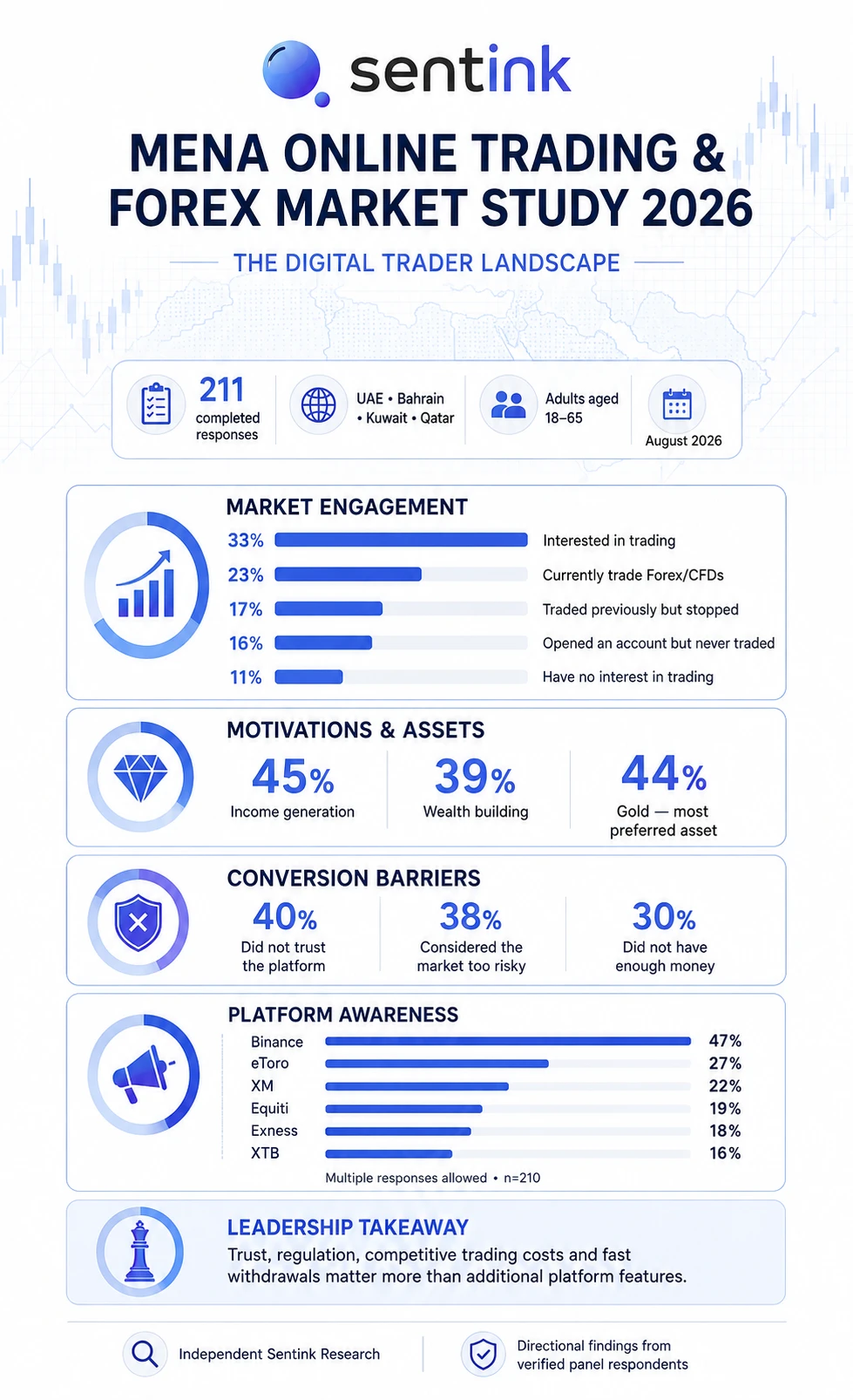
- 33% of respondents chose "I am interested in trading", against 23% for "I currently trade Forex/CFDs".YouTube and Search are the primary drivers for income-seeking investors, with Gold as the preferred asset for wealth generation.
- "Binance" accounts for 47% of the answers and "eToro" for 27%.
- "YouTube" reaches 14% among Process too long and 40% among Privacy concerns — a gap of 26 points.
- "Didn't trust platform" accounts for 40% of the answers and "Market too risky" for 38%.Platform distrust and market fear prevent 38% of potential depositors from funding accounts, costing significant acquisition revenue.
- "Very Important" reaches 21% among High risk and 40% among Lost money — a gap of 19 points.
- "2 - Unsatisfied" reaches 2% among Yes and 100% among No — a gap of 98 points.
- Traders Demand Low Execution Fees and Fast Withdrawals Over Additional Platform Features.
- Regulatory Licensing and Direct Local Bank Integration Form the Core Foundation of Broker Loyalty.
Executive insights
YouTube and Search Capture Income-Seeking Investors Motivated by Wealth Generation and Gold Assets
Executive insight
The pursuit of wealth generation and income is increasingly channeled through digital platforms, with YouTube and Google Search emerging as the primary gateways for MENA investors. This shift signifies a move away from traditional advice channels, driven by a desire for accessible, self-directed learning and asset growth. Investors are not merely seeking quick profits; they are actively looking to build long-term wealth, with 45% citing income generation and 39% wealth building as their core motivations. Notably, Gold stands out as the most popular asset class (44%), suggesting a preference for tangible, perceived-safe-haven assets among this digitally-native investor base, a trend that warrants deeper understanding regarding risk appetite and market sentiment.
Strategic implication
This finding directly impacts customer acquisition and marketing strategy by highlighting dominant digital discovery channels. It also influences product development and content strategy, emphasizing the need to align offerings with wealth-building objectives and tangible asset preferences. Investment priorities should shift towards optimizing presence and engagement on these key platforms to capture this income-seeking demographic.
Share of respondents
Recommended actions
- Develop targeted YouTube and Google Search advertising campaigns showcasing long-term wealth-building strategies and the appeal of Gold as an asset.
- Create educational content series on YouTube and through Google Search partnerships that demystify Gold investment and its role in income generation.
- Launch a 'Financial Independence' content hub accessible via search, catering to the 15% seeking this outcome and linking it to wealth-building assets.
- Pilot a 'Gold Rush' promotional campaign for new account sign-ups driven from YouTube and Search discovery channels.
Exness Achieves Peak Active Usage Despite Binance's Dominant Top-of-Mind Awareness
Executive insight
"Binance" absorbs 47% of choice, a concentration that narrows the real competitive contest down to a single factor. The 20-point distance from "eToro" is not a marginal preference — it is a settled priority order that holds before price enters the conversation. Everything else divides just 149% between it, a share that rarely justifies the campaign and development spend it attracts. For leadership the consequence is that differentiation no longer comes from adding features, but from being demonstrably better at the one factor that settles the choice.
Strategic implication
On acquisition spend, leading with "Binance" raises efficiency because it speaks to the reason for choosing rather than to a supporting attribute. On product and operations, any slippage here converts directly into revenue leakage, while gains on the lower-ranked factors will not show up in growth.
Share of respondents
Recommended actions
- Lead the offer page with "Binance" instead of listing it among general benefits.
- Redirect part of the "eToro" budget into holding performance on "Binance" before funding anything new.
Document Heavy Verification Processes Trigger Severe Dropoff Among Social Media Acquired Leads
Executive insight
The sample splits on "Friends & family" by 29 points between Process too long and Privacy concerns — too wide a gap for one message to cover. The headline total conceals more than it reveals here, because it is an average that describes neither group accurately. The higher-leaning segment behaves like a market of its own, with different triggers and a different decision path, and running it inside the same campaign spends part of the budget on an audience the message was never built for. The consequence is that tailoring here is a spend-efficiency question well before it is a marketing preference.
Strategic implication
On acquisition, a single unified campaign serves one group at the other's expense and raises the cost of reaching the less responsive segment. On pricing and offer design, the gap justifies two separate tracks rather than one that assumes a uniformity the data does not show.
Share within each segment
Process too long
Privacy concerns
Recommended actions
- Split the Process too long and Privacy concerns messaging in the next campaign instead of running one combined offer.
- Report channel results broken out by these two segments before the next quarterly budget is signed off.
Broker Trust Deficits and Market Volatility Hesitation Stop One-in-Four Registered Users From Depositing
Executive insight
The persistent friction from social media acquisition channels, previously identified, is now compounded by a significant trust deficit and perceived market risk among potential depositors. Nearly half (38%) of registered users who haven't deposited cite market volatility as a primary concern, a sentiment amplified by a substantial 40% who explicitly distrust the platform itself. This dual barrier means that even with a completed registration, the leap to funding an account is blocked for a quarter of these users. The underlying behaviour is a cautious investor base in MENA, wary of both external market forces and the integrity of the trading environment, especially when entering from less established acquisition routes.
Strategic implication
This trust gap and risk aversion directly impact customer acquisition cost and conversion rates, particularly for digitally-sourced leads. It necessitates a re-evaluation of marketing spend efficiency and highlights a critical need to bolster platform credibility and perceived stability to unlock deposited revenue.
Share of respondents
Based on a survey of 435 MENA online trading and Forex users, with 211 completing the study. Data on deposit hesitation from n=40 respondents.
Recommended actions
- Develop and prominently feature transparent risk management resources and platform security assurances on the website and within onboarding flows for newly registered users.
- Implement a targeted educational campaign for registered users highlighting strategies to navigate market volatility, using anonymized case studies of successful risk mitigation.
- Review and streamline the deposit process to minimize any perceived friction points that could exacerbate existing user anxieties about platform trustworthiness.
- Pause incremental spend on social media acquisition channels until user trust metrics show material improvement.
Rapid Capital Loss Drives Early Trader Churn Even Among Users Satisfied With Platform Usability
Executive insight
The sample splits on "Very Important" by 19 points between High risk and Lost money — too wide a gap for one message to cover. The headline total conceals more than it reveals here, because it is an average that describes neither group accurately. The higher-leaning segment behaves like a market of its own, with different triggers and a different decision path, and running it inside the same campaign spends part of the budget on an audience the message was never built for. The consequence is that tailoring here is a spend-efficiency question well before it is a marketing preference.
Strategic implication
On acquisition, a single unified campaign serves one group at the other's expense and raises the cost of reaching the less responsive segment. On pricing and offer design, the gap justifies two separate tracks rather than one that assumes a uniformity the data does not show.
Share within each segment
Reason for Stopping
Platform Usability Importance
Recommended actions
- Split the High risk and Lost money messaging in the next campaign instead of running one combined offer.
- Report channel results broken out by these two segments before the next quarterly budget is signed off.
Execution Speed and Withdrawal Mechanics Dictate Post-Verification Platform Retention
Executive insight
The sample splits on "2 - Unsatisfied" by 98 points between Yes and No — too wide a gap for one message to cover. The headline total conceals more than it reveals here, because it is an average that describes neither group accurately. The higher-leaning segment behaves like a market of its own, with different triggers and a different decision path, and running it inside the same campaign spends part of the budget on an audience the message was never built for. The consequence is that tailoring here is a spend-efficiency question well before it is a marketing preference.
Strategic implication
On acquisition, a single unified campaign serves one group at the other's expense and raises the cost of reaching the less responsive segment. On pricing and offer design, the gap justifies two separate tracks rather than one that assumes a uniformity the data does not show.
Share within each segment
Recommended actions
- Split the Yes and No messaging in the next campaign instead of running one combined offer.
- Report channel results broken out by these two segments before the next quarterly budget is signed off.
Traders Demand Low Execution Fees and Fast Withdrawals Over Additional Platform Features
Executive insight
The split in tone is not an even distribution — it leans clearly positive. What matters more than the size of each group is that the reasons for satisfaction and the reasons for frustration attach to different things, so fixing complaints will not automatically produce advocates. Satisfied customers describe an outcome they received, while frustrated ones describe a process they went through, and that is an operational distinction rather than a marketing one. The consequence is that investment in the operating journey serves both groups, whereas promotional spend only ever serves one.
Strategic implication
On customer experience, repeated process complaints point to a fixable breakage that costs far less to repair than replacing the customers it loses. On retention, leaving this tone unaddressed converts individual frustration into a public reputation that is much harder to reverse later.
Share of analysed feedback
Positive
Praise concentrates on the end result.
Negative
Complaints concentrate on the service journey.
Recommended actions
- Tag negative comments by journey stage and fix the most frequently named stage first.
- Move the tone metric into the monthly operations review instead of leaving it in marketing reporting.
Regulatory Licensing and Direct Local Bank Integration Form the Core Foundation of Broker Loyalty
Executive insight
The split in tone is not an even distribution — it leans clearly positive. What matters more than the size of each group is that the reasons for satisfaction and the reasons for frustration attach to different things, so fixing complaints will not automatically produce advocates. Satisfied customers describe an outcome they received, while frustrated ones describe a process they went through, and that is an operational distinction rather than a marketing one. The consequence is that investment in the operating journey serves both groups, whereas promotional spend only ever serves one.
Strategic implication
On customer experience, repeated process complaints point to a fixable breakage that costs far less to repair than replacing the customers it loses. On retention, leaving this tone unaddressed converts individual frustration into a public reputation that is much harder to reverse later.
Verbatim feedback
Lack of trust / Regulation concerns (e.g., wanting more local licensing or higher investor protection)
It is difficult to withdraw the money if the bank is not tied up with the trading company
I have come across two only Exness and peperstone I chose and love perperston because they usually put their traders in A book category unlike Exness they take about 5 months before putting you in an Abook category
Recommended actions
- Add a short follow-up after every resolved complaint to measure recovery rather than satisfaction.
- Put the open-comment summary in front of the weekly leadership meeting, not the monthly pack.
Cross-tabulation
Segment relationships from pairwise cross-tabulation — percentages show row share within each answer category.
Gender × Did you complete identity verification (KYC)?
92-point gap between Female and Prefer not to say
For "Yes": 92% of Female vs 0% of Prefer not to say (153 respondents answered both questions).
| Gender | ||
|---|---|---|
| Male (n=90) | 84%76 | 16%14 |
| Female (n=62) | 92%57 | 8%5 |
| Prefer not to say (n=1) | 0%0 | 100%1 |
- 50%Male ×
- 37%Female ×
- 9%Male ×
- 3%Female ×
This is the level of cross-tab analysis you get automatically — try it on your data.
Try SentinkSentiment analysis
Sentiment analysis of 118 open-ended responses: 77% Neutral, 17% Positive, 5% Negative, 1% Mixed.
Responses analyzed: 118 · Neutral
- Neutral77%91
- Positive17%20
- Negative5%6
- Mixed1%1
What this means
The dominant tone in open-ended responses is Neutral (77%), indicating respondents primarily express neutral or non-polarized attitudes.
Recommended response
To address the Neutral segment (77% of open-ended responses), review touchpoints driving this tone and adapt messaging to respond to this audience's concerns.
Sample themes from open-ended answers
- Positive
Demonstrates clear emotional satisfaction and high enthusiasm, highlighting a very favorable user experience.
- Positive
It is a life changing game
Exhibits extreme excitement and transformative impact, reflecting high enthusiasm for a revolutionary experience.
- Neutral
A brief negative particle used as a rejection implies indifference rather than strong hostility, reflecting low conversational investment.
- Neutral
A direct rejection highlights passive non-participation, showing that the respondent remains entirely unengaged with the prompt.
Market assumptions tested
What the market believes, set against what the evidence shows.
Market assumption
Demand is fragmented across many competing preferences.
What the research found
Binance alone accounts for 47% of choices.
Business implication
One well-executed position covers most of the market; a broad portfolio spreads the same spend thin.
Executive recommendations
Grouped by the function that owns the decision.
Marketing
- Develop targeted YouTube and Google Search advertising campaigns showcasing long-term wealth-building strategies and the appeal of Gold as an asset.
- Pilot a 'Gold Rush' promotional campaign for new account sign-ups driven from YouTube and Search discovery channels.
- Lead the offer page with "Binance" instead of listing it among general benefits.
- Split the Process too long and Privacy concerns messaging in the next campaign instead of running one combined offer.
Product
- Develop and prominently feature transparent risk management resources and platform security assurances on the website and within onboarding flows for newly registered users.
Customer experience
- Tag negative comments by journey stage and fix the most frequently named stage first.
- Add a short follow-up after every resolved complaint to measure recovery rather than satisfaction.
- Address the 40% of users who did not deposit due to 'Didn't trust platform' by prominently showcasing security and regulation (cited as 'Extremely Important' by 28% and 'Very Important' by 34% of all respondents) earlier in the user journey.
Operations
- Review and streamline the deposit process to minimize any perceived friction points that could exacerbate existing user anxieties about platform trustworthiness.
- Move the tone metric into the monthly operations review instead of leaving it in marketing reporting.
- Reduce the 35% of non-verifiers citing 'Process too long' by simplifying KYC documentation requirements, a key barrier for 25% of this segment, and addressing privacy concerns which also affect 25%.
Technology
- Counteract the 53% of lapsed traders citing 'High risk' and 50% citing 'Lost money' by integrating educational content and risk management tools, particularly for the 73% who intend to try a new platform in the next 12 months.
- Leverage the 47% of new traders who first heard about online trading via YouTube and 33% via TikTok, as these platforms are disproportionately used by the younger 25-34 age demographic (52% of total sample).
Investment
- Create educational content series on YouTube and through Google Search partnerships that demystify Gold investment and its role in income generation.
- Redirect part of the "eToro" budget into holding performance on "Binance" before funding anything new.
Strategic priorities
- Launch a 'Financial Independence' content hub accessible via search, catering to the 15% seeking this outcome and linking it to wealth-building assets.
- Put the open-comment summary in front of the weekly leadership meeting, not the monthly pack.
Methodology
Independent Sentink ResearchReal respondents and real collected data. ‘Independent Sentink Research’ means the study was funded by Sentink rather than commissioned by a paying client.How this research was conducted
Methodology
Independent Sentink ResearchReal respondents and real collected data. ‘Independent Sentink Research’ means the study was funded by Sentink rather than commissioned by a paying client.- Sample
- 213 completed respondents
- Completion rate
- 100%
- Questions
- 52 questions
- Estimated interview length
- 5 minutes
Download the full executive research report
The complete analysis, with every chart, segment breakdown and recommendation.
- 11pages
- 6charts
- 8executive analyses
- 17strategic recommendations
PDF • 233 KB
Survey infographic
A visual summary of respondent profiles, key metrics, and top findings from this study.
Frequently asked questions
What are the key findings on mena online trading & forex market?
YouTube and Search are the primary drivers for income-seeking investors, with Gold as the preferred asset for wealth generation. "Binance" settles the decision before the customer ever reaches a price comparison. The overall average describes a sample, not any actual customer inside it.
How do the results differ by segment?
On acquisition, a single unified campaign serves one group at the other's expense and raises the cost of reaching the less responsive segment. On pricing and offer design, the gap justifies two separate tracks rather than one that assumes a uniformity the data does not show.
What should leadership do first?
Develop targeted YouTube and Google Search advertising campaigns showcasing long-term wealth-building strategies and the appeal of Gold as an asset. Create educational content series on YouTube and through Google Search partnerships that demystify Gold investment and its role in income generation.
How was this research conducted?
213 completed respondents.