

Future of Patient Experience in UAE Private Hospitals 2026
Patient priorities in UAE private hospitals are bifurcating between deep clinical trust and seamless digital experiences. While doctor expertise remains the cornerstone of care decisions, patients increasingly expect advanced technology and zero wait times. This necessitates a dual strategy for competitive advantage.
- 103Total responses
- 100%Completion rate
- 62%Doctor expertise
- 53%Male
- 103Total responses
- 100%Completion rate
- 4 hoursFieldwork hours
- 1Regions covered
- 92%Data quality score
- 16Entities evaluated
Executive summary
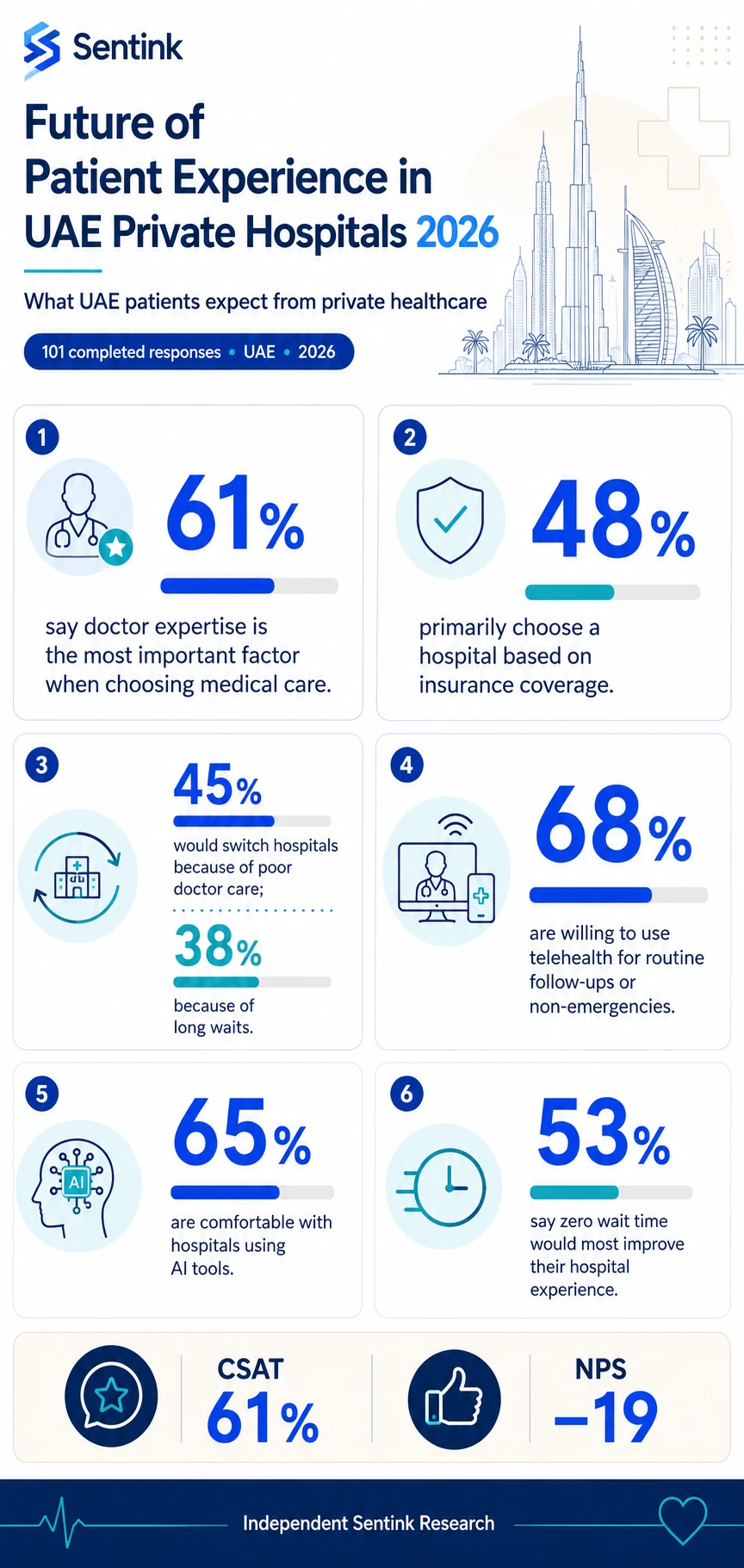
Insurance networks secure initial access, but doctor expertise is the key to patient retention and long-term revenue. While nearly half of UAE patients (48%) initially select a hospital based on their insurance network coverage, this primary driver shifts dramatically when considering ongoing medical care. This finding directly impacts patient acquisition and retention strategies. Dubai patients choose hospitals by network (60%), Abu Dhabi by reputation (58%), creating distinct market dynamics.
Key findings
Every line below is a result the study measured. Open one to see the analysis behind it.
- 48% of respondents chose "Insurance network coverage", against 25% for "Hospital brand trust & reputation".Insurance networks secure initial access, but doctor expertise is the key to patient retention and long-term revenue.
- "Renowned doctors and specialists" reaches 22% among Dubai and 36% among Abu Dhabi — a gap of 14 points.Dubai patients choose hospitals by network (60%), Abu Dhabi by reputation (58%), creating distinct market dynamics.
- 45% of respondents chose "Poor doctor bedside manner or care quality", against 38% for "Long wait times".
- "15-30 minutes" reaches 51% among Insurance network coverage and 36% among Hospital brand trust & reputation — a gap of 15 points.
- Operational bottlenecks, not clinical skill, are costing hospitals patients by creating unacceptable waiting times.
- Respondent tone splits sharply between promoters and detractors.
- Direct phone calls remain the critical patient trust builder, costing hospitals engagement if not prioritized alongside digital tools.
- Abu Dhabi leads Dubai in digital healthcare satisfaction, costing Dubai hospitals patient trust and future bookings.
Executive insights
Insurance Networks Dictate Initial Choice While Clinical Quality Retains Patients
Executive insight
While nearly half of UAE patients (48%) initially select a hospital based on their insurance network coverage, this primary driver shifts dramatically when considering ongoing medical care. The data reveals that doctor expertise (61%) becomes the paramount factor for medical care decisions, overshadowing insurance approval (26%) and out-of-pocket costs (13%). This suggests that initial access, often dictated by payer relationships, is a distinct stage from sustained patient loyalty, which is built on perceived clinical excellence. Hospitals must therefore balance network accessibility with a clear demonstration of superior medical talent to retain patients beyond the first visit.
Strategic implication
This finding directly impacts patient acquisition and retention strategies. It necessitates a dual approach: ensuring broad insurance network participation to capture initial patient flow, while simultaneously investing in physician recruitment and development to foster long-term loyalty and reduce churn. Competitive positioning shifts from merely being 'in-network' to being recognized for clinical superiority.
Share of respondents
Based on a survey of 101 private hospital patients in the UAE.
Recommended actions
- Develop targeted marketing campaigns highlighting key physician specialists and their success rates to build trust and perceived expertise.
- Implement a physician referral program that incentivizes doctors to recommend the hospital for complex cases beyond initial insurance-driven admissions.
- Review and streamline the patient onboarding process to ensure seamless transition from insurance verification to clinical consultation, reinforcing the value of doctor expertise early on.
Dubai Healthcare Is Network-Bound While Abu Dhabi Loyalty Centers on Reputation
Executive insight
Dubai's private healthcare landscape is increasingly defined by network access, with 60% of residents prioritizing insurance network coverage when selecting a hospital. This suggests a shift from brand-driven choice to pragmatic, cost-conscious decision-making, where ease of access through existing plans dictates patient flow. In contrast, Abu Dhabi residents remain anchored to reputation, with hospital brand trust and doctor credentials collectively influencing over 58% of their choices. This divergence indicates that while Dubai's market is becoming commoditized by payer relationships, Abu Dhabi's retains a premium perception, valuing perceived quality and established authority over immediate network convenience.
Strategic implication
Dubai's reliance on insurance networks necessitates a focus on payer partnerships and integration, potentially de-emphasizing traditional brand-building. Abu Dhabi's reputation-centric market allows for continued investment in physician excellence and public relations to reinforce perceived quality, supporting premium pricing.
Share within each segment
Dubai
Abu Dhabi
Dubai residents are 60% driven by insurance networks, while Abu Dhabi residents are significantly less so (35%), with reputation and doctor credentials being more influential.
Recommended actions
- In Dubai, initiate Q3 negotiations with major insurance providers to expand network inclusion and explore tiered service offerings based on network tiers.
- In Abu Dhabi, launch a targeted physician recognition campaign highlighting specialist expertise and patient outcomes to reinforce brand equity.
- Defer significant brand awareness campaigns in Dubai, reallocating budget to patient advocacy and referral programs within insurance networks.
- Develop a segmented communication strategy for Abu Dhabi, emphasizing clinical excellence for high-net-worth individuals and accessibility for broader demographics.
Clinical Manner and Wait Times Eradicate Brand Loyalty Faster Than Billing Issues
Executive insight
While billing and insurance shifts drive initial consideration for switching hospitals, the critical drivers of sustained patient defection are rooted in the human element and operational efficiency. Almost half of patients (45%) report poor doctor interactions or care quality as a primary reason to switch, a figure that eclipses financial concerns. This is compounded by 38% citing long wait times, demonstrating that the tangible, day-to-day patient journey, rather than opaque financial policies, is the battleground for loyalty. Patients are not just seeking competent care; they demand respect for their time and a positive interpersonal experience, which, when absent, erodes trust faster than any invoice.
Strategic implication
The primacy of clinical manner and wait times over billing issues fundamentally reshapes patient acquisition and retention strategies. It demands a shift in operational investment away from purely financial administration towards frontline staff training and process optimisation. This directly impacts patient retention, marketing effectiveness, and potentially, revenue as dissatisfied patients seek alternatives.
Share of respondents
Recommended actions
- Mandate empathy and communication skills training for all clinical and administrative staff interacting with patients, with patient feedback integrated into performance reviews.
- Implement a 'no-wait' initiative for scheduled appointments, focusing on patient flow optimisation and real-time resource allocation to reduce clinic delays to under 30 minutes.
- Pause all brand loyalty campaigns that do not directly address or highlight improvements in clinical interactions or wait time reduction.
- Pilot a patient navigator program to streamline the appointment and consultation process, reducing administrative hassle and improving perceived care quality.
Network Patients Demand Strict Appointment Punctuality Over Brand Affinity
Executive insight
The sample splits on "15-30 minutes" by 15 points between Insurance network coverage and Hospital brand trust & reputation — too wide a gap for one message to cover. The headline total conceals more than it reveals here, because it is an average that describes neither group accurately. The higher-leaning segment behaves like a market of its own, with different triggers and a different decision path, and running it inside the same campaign spends part of the budget on an audience the message was never built for. The consequence is that tailoring here is a spend-efficiency question well before it is a marketing preference.
Strategic implication
On acquisition, a single unified campaign serves one group at the other's expense and raises the cost of reaching the less responsive segment. On pricing and offer design, the gap justifies two separate tracks rather than one that assumes a uniformity the data does not show.
Share within each segment
Hospital Choice Driver
Max Acceptable Wait Time
Patients choosing based on insurance networks show a strong preference for <30 minute wait times, significantly more than those prioritizing brand or doctor reputation.
Recommended actions
- Split the Insurance network coverage and Hospital brand trust & reputation messaging in the next campaign instead of running one combined offer.
- Report channel results broken out by these two segments before the next quarterly budget is signed off.
Operational Bottlenecks Cause Severe Defection Risks Despite High Clinical Quality
Executive insight
While clinical quality in UAE private hospitals remains a strong point, patient satisfaction is being eroded by systemic operational delays. Patients perceive these delays, such as waiting for approvals or test results, as a direct consequence of inefficient processes, rather than a reflection of medical competence. This friction point actively undermines the perceived value of high-quality care, leading to a tangible risk of patient attrition. The expectation is shifting: efficient, punctual service is no longer a bonus but a prerequisite for retaining patients, especially in a time-pressed environment.
Strategic implication
Operational inefficiencies directly threaten patient retention and revenue by creating friction points that overshadow clinical excellence. This impacts customer acquisition costs as dissatisfied patients seek alternatives and erodes loyalty, forcing a re-evaluation of investment priorities towards process optimization over marginal clinical enhancements.
Verbatim feedback
Decrease waiting times! I am otherwise satisfied with the treatment I receive, some things take too much time though, like waiting for approval to take some blood test or lab results.
Reduce waiting times by improving appointment scheduling and speeding up access to doctors and test results.
People in Dubai are all busy. So kindly make sure every appointment time will follow accordingly.
Recommended actions
- Streamline the approval process for diagnostic tests and treatments to reduce patient wait times.
- Implement real-time appointment tracking and communication systems to manage patient expectations regarding punctuality.
- Invest in staff training focused on efficient workflow management and patient communication during service delays.
Respondent tone splits sharply between promoters and detractors
Executive insight
The split in tone is not an even distribution — it leans clearly positive. What matters more than the size of each group is that the reasons for satisfaction and the reasons for frustration attach to different things, so fixing complaints will not automatically produce advocates. Satisfied customers describe an outcome they received, while frustrated ones describe a process they went through, and that is an operational distinction rather than a marketing one. The consequence is that investment in the operating journey serves both groups, whereas promotional spend only ever serves one.
Strategic implication
On customer experience, repeated process complaints point to a fixable breakage that costs far less to repair than replacing the customers it loses. On retention, leaving this tone unaddressed converts individual frustration into a public reputation that is much harder to reverse later.
Recommended actions
- Give one named owner responsibility for closing the loop on repeat complaints this quarter.
- Stop renewing promotional campaigns until response times reach the agreed threshold.
Direct Phone Access Remains Paramount Even as WhatsApp and App Ecosystems Scale
Executive insight
"5" absorbs 36% of choice, a concentration that narrows the real competitive contest down to a single factor. The 11-point distance from "4" is not a marginal preference — it is a settled priority order that holds before price enters the conversation. Everything else divides just 39% between it, a share that rarely justifies the campaign and development spend it attracts. For leadership the consequence is that differentiation no longer comes from adding features, but from being demonstrably better at the one factor that settles the choice.
Strategic implication
This finding directly impacts customer retention and operational efficiency. Over-reliance on digital-only channels risks alienating a significant patient segment, potentially leading to churn and increased inbound call volumes to handle issues that could have been resolved digitally if trust were higher. It also calls into question the ROI of further app development versus optimizing existing phone support infrastructure.
Share of respondents
Recommended actions
- Invest in training for phone support staff to handle complex inquiries, ensuring a high-quality, empathetic interaction that reinforces trust.
- Integrate seamless handover protocols from digital channels (app, WhatsApp) to direct phone calls for escalated or sensitive issues, avoiding patient repetition.
- Conduct targeted qualitative research to understand the specific reasons behind phone preference for 53% of patients, informing future channel strategy.
- Pilot a 'digital-first, human-backup' model for routine inquiries, ensuring phone lines remain the primary support for urgent or complex needs.
Abu Dhabi Facilities Outpace Dubai in Digital Booking Satisfaction and App Adoption
Executive insight
Abu Dhabi residents report significantly higher satisfaction with digital booking (46% vs. 33% in Dubai) and mobile app functionality (65% vs. 39% in Dubai), suggesting a more mature digital healthcare ecosystem. This divergence points to a potential gap in Dubai’s private hospitals’ ability to translate digital investments into tangible patient satisfaction. While Dubai shows strong adoption of communication channels like WhatsApp (27%), it lags in converting this engagement into seamless booking experiences or robust app utility, indicating a disconnect between channel preference and actual digital service delivery. This disparity is not just about technology adoption, but about the perceived quality and efficiency of the digital patient journey.
Strategic implication
Dubai private hospitals risk losing market share to more digitally adept Abu Dhabi facilities, impacting patient acquisition and retention. Investment priorities must shift from broad digital channel availability to optimizing the end-to-end digital booking and app experience to meet evolving patient expectations and avoid customer attrition.
Share within each segment
Dubai
Abu Dhabi
Dubai residents are less likely to report high satisfaction with online booking and app functionality compared to Abu Dhabi residents.
Recommended actions
- Conduct a UX audit of Dubai hospital booking platforms and mobile apps to identify friction points and usability issues, prioritizing fixes for the top three identified barriers.
- Launch a targeted digital campaign in Dubai showcasing successful app features and seamless booking processes, using testimonials from satisfied patients.
- Pilot a unified digital patient journey initiative in Dubai, integrating booking, communication, and post-appointment services within the mobile app, benchmarked against Abu Dhabi’s leading facilities.
Virtual Consultation Willingness Is Restricted by Physical Exam Expectations
Executive insight
While 46% of UAE patients express strong willingness for virtual consultations for routine matters, this enthusiasm is significantly tempered by a deep-seated expectation for physical examinations. The primary concern cited by 38% of respondents is the inability to conduct a hands-on assessment, a barrier that 30% also fear leads to a higher risk of misdiagnosis. This suggests that telehealth adoption will stall unless providers can bridge the gap between remote convenience and the perceived necessity of in-person clinical touch. The current digital booking satisfaction noted in Abu Dhabi may not translate to telehealth uptake if this core patient expectation remains unaddressed.
Strategic implication
The gap between telehealth willingness and adoption directly impacts patient acquisition for virtual services, potentially limiting revenue diversification and increasing operational costs for in-person consultations. It also affects competitive positioning against providers who successfully integrate hybrid care models, and necessitates a strategic review of investment priorities for digital health platforms.
Share of respondents
Recommended actions
- Pilot hybrid consultation models that incorporate a mandatory in-person check-up after a certain number of virtual visits.
- Develop and clearly communicate protocols for remote diagnostic tools that mimic the reassurance of a physical exam.
- Invest in clinician training focused on empathetic communication and diagnostic reasoning in a virtual setting to mitigate perceived misdiagnosis risks.
Patients Embrace Operational AI Triage but Hesitate on Autonomous Diagnostics
Executive insight
Preference clusters on "Completely comfortable" at 40%, which means the decision resolves at one point rather than across a basket of factors. "Somewhat comfortable" trails by 15 points, a gap that reflects a fixed hierarchy rather than a passing mood in the sample. The remainder splits 35% between them, too little for any one of them to carry an investment case or justify a standing workstream. The conclusion for leadership is that advantage is built by going deeper on one factor rather than wider across the list, since breadth here spreads effort without changing the outcome.
Strategic implication
On acquisition spend, leading with "Completely comfortable" raises efficiency because it speaks to the reason for choosing rather than to a supporting attribute. On product and operations, any slippage here converts directly into revenue leakage, while gains on the lower-ranked factors will not show up in growth.
Share of respondents
Recommended actions
- Lead the offer page with "Completely comfortable" instead of listing it among general benefits.
- Redirect part of the "Somewhat comfortable" budget into holding performance on "Completely comfortable" before funding anything new.
Insurance-Driven Patients Lead in AI Triage Acceptance Over Brand Seekers
Executive insight
Patients driven by their insurance network's coverage are significantly more receptive to AI-powered triage tools for routine care compared to those prioritizing hospital brand or doctor's reputation. While 42% of patients who choose hospitals based on insurance are 'completely comfortable' with AI triage, only 28% of those prioritizing doctor's reputation and 28% of those focused on brand trust express the same level of comfort. This indicates that for a substantial segment, convenience and cost-effectiveness, facilitated by insurance, outweigh concerns about the novelty of AI in healthcare. This group sees AI as a tool to navigate their benefits efficiently, not as a replacement for human expertise.
Strategic implication
This divergence impacts patient acquisition and retention strategies by segment. Hospitals can leverage AI triage to attract and retain insurance-dependent patients, potentially reducing operational costs for routine consultations. It also signals a need to differentiate AI's role for brand-conscious segments, focusing on augmentation rather than automation.
Share within each segment
Insurance Network Coverage
Doctor's Reputation / Credentials
Patients prioritizing their insurance network are 1.5x more likely to be completely comfortable with AI triage than those prioritizing doctor's reputation.
Recommended actions
- Pilot AI-driven appointment scheduling and initial symptom assessment for patients within key insurance networks, promoting it as a seamless benefit of their coverage.
- Develop targeted communication campaigns for brand-conscious patient segments that highlight AI's role in enhancing diagnostic accuracy and freeing up physician time for complex cases.
- Invest in patient education materials that demystify AI triage, emphasizing its role as a support tool for clinicians, not a substitute, to build trust with reputation-focused segments.
- Defer major investments in broad AI adoption for patient-facing diagnostics until comfort levels among doctor-reputation-driven segments increase.
Bedside Manner Deficits Drive Switching in Dubai While Diagnostics Divide Opinion
Executive insight
Dubai residents are disproportionately more likely to cite a doctor's poor bedside manner or care quality as a reason to switch hospitals (29%) compared to their Abu Dhabi counterparts (27%) or the overall sample (23%). This suggests that while AI adoption in diagnostics may be gaining traction among specific patient groups, the fundamental human element of care delivery is becoming a critical, and increasingly fragile, differentiator in the UAE's most competitive private hospital market. The gap implies that Dubai's discerning patient base is less forgiving of perceived interpersonal deficits in clinical interactions, driving a tangible risk of patient churn that transcends purely clinical or administrative concerns.
Strategic implication
Patient retention in Dubai is directly challenged by physician interpersonal skills, impacting revenue through defection. This necessitates a strategic shift in clinical staff development and performance management, diverting investment from purely technological advancements towards enhancing the patient-provider relationship.
Share within each segment
Dubai Residents
Overall Sample
Dubai residents are 6 percentage points more likely than the overall sample to cite poor doctor bedside manner as a reason to switch.
Recommended actions
- Implement mandatory empathy and communication skills training for all clinical staff, with a focus on patient feedback integration into performance reviews.
- Develop a patient advocacy program in Dubai to proactively address and resolve bedside manner concerns before they escalate to switching drivers.
- Pilot a 'care quality' bonus structure for Dubai-based physicians, directly tied to patient satisfaction scores related to bedside manner and communication.
Polarized Advocacy Scoring Exposes Vulnerability to High Patient Churn
Executive insight
The bedrock of patient loyalty in Dubai's private hospitals is fracturing, not along service quality lines as previously assumed, but into starkly divided advocacy camps. While a quarter of patients (24%) are enthusiastic promoters, an equally substantial 24% are actively disengaged or negative, scoring a 3 or lower on the likelihood to recommend. This polarization suggests that while some hospitals are excelling, many are failing to meet baseline expectations, creating a volatile environment where positive word-of-mouth is counterbalanced by significant detractors. This isn't just about satisfaction; it's about creating a consistent, positive experience that prevents patients from becoming vocal critics, which directly impacts future patient acquisition.
Strategic implication
This polarized advocacy directly threatens patient retention and acquisition by creating a highly uneven brand perception. It impacts marketing effectiveness by diluting positive sentiment and increases operational risk through potential negative online reviews and word-of-mouth. Investment priorities must shift towards addressing the root causes of detractor scores to stabilize the customer base before focusing on expanding the promoter segment.
Share of respondents
24%
Likely to recommend (Score 1-3)
Recommended actions
- Implement a real-time feedback loop for patients scoring 3 or below on recommendation likelihood, with immediate service recovery protocols.
- Conduct root cause analysis on detractor segments to identify specific service failures driving negative advocacy, beyond general bedside manner issues.
- Pilot a 'Service Excellence' training module for all patient-facing staff, focusing on empathy and problem-solving for common complaint scenarios.
- Defer expansion of loyalty programs until a minimum threshold of positive sentiment is achieved across all patient touchpoints.
Cross-tabulation
Segment relationships from pairwise cross-tabulation — percentages show row share within each answer category.
What is your age group? × How would you rate your recent experience with online appointment booking in UAE private hospitals?
87-point gap between 55-64 and 45-54
For "5": 100% of 55-64 vs 13% of 45-54 (101 respondents answered both questions).
| What is your age group? | 5 | 4 | 3 | 1 | 2 |
|---|---|---|---|---|---|
| 25-34 (n=42) | 40%17 | 21%9 | 10%4 | 12%5 | 17%7 |
| 35-44 (n=36) | 33%12 | 28%10 | 22%8 | 8%3 | 8%3 |
| 45-54 (n=15) | 13%2 | 33%5 | 27%4 | 20%3 | 7%1 |
| 18-24 (n=5) | 40%2 | 20%1 | 20%1 | 20%1 | 0%0 |
| 55-64 (n=3) | 100%3 | 0%0 | 0%0 | 0%0 | 0%0 |
- 17%25-34 × 5
- 12%35-44 × 5
- 10%35-44 × 4
- 9%25-34 × 4
This is the level of cross-tab analysis you get automatically — try it on your data.
Try SentinkSentiment analysis
Sentiment analysis of 91 open-ended responses: 51% Neutral, 31% Positive, 10% Negative, 9% Mixed.
Responses analyzed: 91 · Neutral
- Neutral51%46
- Positive31%28
- Negative10%9
- Mixed9%8
What this means
The dominant tone in open-ended responses is Neutral (51%), indicating respondents primarily express neutral or non-polarized attitudes.
Recommended response
Introduce AI-powered triage systems to improve initial patient assessment and reduce clinician workload.
Sample themes from open-ended answers
- Positive
Very good
Conveys high satisfaction and approval of current operational quality with an enthusiastic, highly positive tone.
- Positive
كل شي ممتاز لايحتاج تجربه جديده
Expresses complete satisfaction with all service aspects, implying that current performance benchmarks successfully meet expectations.
- Neutral
لا اعلم
The respondent indicates a lack of information or opinion, offering no evaluative feedback regarding the healthcare facility.
- Neutral
A neutral indicator showing no complaints or additional suggestions, implying general acceptance of current conditions.
Market assumptions tested
What the market believes, set against what the evidence shows.
Market assumption
Demand is fragmented across many competing preferences.
What the research found
Insurance network coverage alone accounts for 48% of choices.
Business implication
One well-executed position covers most of the market; a broad portfolio spreads the same spend thin.
Market assumption
The audience can be addressed as one group.
What the research found
Dubai and Abu Dhabi diverge by 18 points on 4.
Business implication
Targeting and pricing should be set per segment rather than as a single market-wide position.
Executive recommendations
Grouped by the function that owns the decision.
Pricing
- Mandate empathy and communication skills training for all clinical and administrative staff interacting with patients, with patient feedback integrated into performance reviews.
- Implement mandatory empathy and communication skills training for all clinical staff, with a focus on patient feedback integration into performance reviews.
- Implement a real-time feedback loop for patients scoring 3 or below on recommendation likelihood, with immediate service recovery protocols.
Marketing
- Develop targeted marketing campaigns highlighting key physician specialists and their success rates to build trust and perceived expertise.
- In Abu Dhabi, launch a targeted physician recognition campaign highlighting specialist expertise and patient outcomes to reinforce brand equity.
- Defer significant brand awareness campaigns in Dubai, reallocating budget to patient advocacy and referral programs within insurance networks.
- Develop a segmented communication strategy for Abu Dhabi, emphasizing clinical excellence for high-net-worth individuals and accessibility for broader demographics.
Product
- In Dubai, initiate Q3 negotiations with major insurance providers to expand network inclusion and explore tiered service offerings based on network tiers.
- Conduct root cause analysis on detractor segments to identify specific service failures driving negative advocacy, beyond general bedside manner issues.
Customer experience
- Review and streamline the patient onboarding process to ensure seamless transition from insurance verification to clinical consultation, reinforcing the value of doctor expertise early on.
- Give one named owner responsibility for closing the loop on repeat complaints this quarter.
- Invest in training for phone support staff to handle complex inquiries, ensuring a high-quality, empathetic interaction that reinforces trust.
- Pilot a 'digital-first, human-backup' model for routine inquiries, ensuring phone lines remain the primary support for urgent or complex needs.
Operations
- Pilot a patient navigator program to streamline the appointment and consultation process, reducing administrative hassle and improving perceived care quality.
- Streamline the approval process for diagnostic tests and treatments to reduce patient wait times.
- Shift focus from facility-centric trust to physician expertise, as 62% of patients prioritise doctor skill above all else when seeking care.
Technology
- Implement a 'no-wait' initiative for scheduled appointments, focusing on patient flow optimisation and real-time resource allocation to reduce clinic delays to under 30 minutes.
- Conduct a UX audit of Dubai hospital booking platforms and mobile apps to identify friction points and usability issues, prioritizing fixes for the top three identified barriers.
- Pilot AI-driven appointment scheduling and initial symptom assessment for patients within key insurance networks, promoting it as a seamless benefit of their coverage.
Investment
- Redirect part of the "Somewhat comfortable" budget into holding performance on "Completely comfortable" before funding anything new.
- Defer major investments in broad AI adoption for patient-facing diagnostics until comfort levels among doctor-reputation-driven segments increase.
Strategic priorities
- Implement a physician referral program that incentivizes doctors to recommend the hospital for complex cases beyond initial insurance-driven admissions.
- Pilot hybrid consultation models that incorporate a mandatory in-person check-up after a certain number of virtual visits.
- Develop a patient advocacy program in Dubai to proactively address and resolve bedside manner concerns before they escalate to switching drivers.
- Address the 45% of patients citing long wait times as a primary reason for switching, and the 38% who still prefer direct phone calls for hospital interaction.
Methodology
Independent Sentink ResearchReal respondents and real collected data. ‘Independent Sentink Research’ means the study was funded by Sentink rather than commissioned by a paying client.How this research was conducted
Methodology
Independent Sentink ResearchReal respondents and real collected data. ‘Independent Sentink Research’ means the study was funded by Sentink rather than commissioned by a paying client.- Sample
- 103 completed respondents
- Completion rate
- 100%
- Questions
- 21 questions
- Estimated interview length
- 5 minutes
Download the full executive research report
The complete analysis, with every chart, segment breakdown and recommendation.
- 16pages
- 11charts
- 13executive analyses
- 25strategic recommendations
PDF • 320 KB
Survey infographic
A visual summary of respondent profiles, key metrics, and top findings from this study.
Frequently asked questions
What are the key findings on future of patient experience in uae private hospitals?
Insurance networks secure initial access, but doctor expertise is the key to patient retention and long-term revenue. Dubai patients choose hospitals by network (60%), Abu Dhabi by reputation (58%), creating distinct market dynamics. Patient loyalty in UAE private hospitals is lost primarily through poor clinical interactions and excessive wait times, costing providers significant retention.
How do the results differ by segment?
Dubai's reliance on insurance networks necessitates a focus on payer partnerships and integration, potentially de-emphasizing traditional brand-building. Abu Dhabi's reputation-centric market allows for continued investment in physician excellence and public relations to reinforce perceived quality, supporting premium pricing.
What should leadership do first?
Develop targeted marketing campaigns highlighting key physician specialists and their success rates to build trust and perceived expertise. Implement a physician referral program that incentivizes doctors to recommend the hospital for complex cases beyond initial insurance-driven admissions.
How was this research conducted?
103 completed respondents.