
UAE Digital Banking Experience & Customer Satisfaction Report 2026
UAE consumers are overwhelmingly digital in their banking preferences, prioritizing seamless app experiences and readily switching for better digital offerings. While trust in security is generally high, a notable minority expresses concern, and customer support satisfaction varies.
- 100Total responses
- 100%Completion rate
- 62%Entirely digital (Mobile app / Online)
- 53%10
- 100Total responses
- 100%Completion rate
- 3 hoursFieldwork hours
- 1Regions covered
- 97%Data quality score
- 12Entities evaluated
Executive summary
Dubai's digital banking users are a distinct, high-intensity segment requiring tailored engagement strategies. Dubai residents exhibit a distinctively higher intensity of mobile banking engagement, with 51% using their primary bank's app daily, far exceeding other emirates. This finding directly impacts customer retention and revenue generation by highlighting a significant engagement gap. "Seamless and fast mobile app experience" settles the decision before the customer ever reaches a price comparison. "Female" absorbs 50% of choice in Gender, which narrows where the offer actually has to win and turns spend elsewhere into a distraction.
Key findings
Every line below is a result the study measured. Open one to see the analysis behind it.
- "Multiple times a week" reaches 41% among Dubai and 59% among Abu Dhabi — a gap of 18 points.Dubai's digital banking users are a distinct, high-intensity segment requiring tailored engagement strategies.
- "Seamless and fast mobile app experience" accounts for 51% of the answers and "Strong security reputation and trust" for 41%.
- Islamic Institutions Command Outsized Security and Personal Data Trust.
- Respondent tone splits sharply between promoters and detractors.
- "Better mobile app interface and digital features" reaches 50% among Dubai Islamic Bank and 39% among FAB (First Abu Dhabi Bank) — a gap of 11 points.Digital interface friction is the primary driver of customer churn at leading Islamic banks, not just a minor inconvenience.
- "Better mobile app interface and digital features" reaches 56% among Very Satisfied and 29% among Satisfied — a gap of 27 points.Exceptional digital support shields customers from fee-driven attrition.
- "Biometric authentication (Face ID / Fingerprint login)" reaches 26% among Very Satisfied and 37% among Satisfied — a gap of 11 points.AI and biometrics are now the bedrock of digital banking satisfaction, not optional enhancements.
- Voice of Customer Demands Simplified Interfaces and One-Tap Task Execution.
Executive insights
Dubai Leads Engagement Intensity While Northern Emirates Maintain Periodic Cadence
Executive insight
Dubai residents exhibit a distinctively higher intensity of mobile banking engagement, with 51% using their primary bank's app daily, far exceeding other emirates. This contrasts sharply with Northern Emirates like Sharjah, where a more periodic cadence of usage, with 25% engaging only a few times a month, prevails. This divergence suggests that Dubai's urban dynamism and potentially higher digital adoption rates foster a continuous banking relationship, whereas other emirates maintain a more traditional, less frequent interaction pattern. The implications are clear: a one-size-fits-all digital strategy will miss critical engagement opportunities in key markets.
Strategic implication
This finding directly impacts customer retention and revenue generation by highlighting a significant engagement gap. It necessitates a differentiated digital product and marketing strategy to deepen relationships in Dubai while potentially re-evaluating the digital service model for the Northern Emirates to drive more consistent interaction and associated transaction opportunities.
Share within each segment
Dubai
Northern Emirates
Data for Northern Emirates aggregated from Sharjah, Ajman, Fujairah, and Ras Alkhaima for comparative analysis against Dubai's daily and multi-weekly engagement.
Recommended actions
- Launch targeted, high-frequency engagement campaigns for Dubai users, emphasizing instant transaction capabilities and personalized financial insights.
- Develop a 'lite' digital banking offering for Northern Emirates users, focusing on essential services and ease of access to encourage more regular usage.
- Pilot a rewards program in Dubai tied to daily app usage to solidify habitual engagement and gather richer behavioral data.
- Investigate friction points in the Northern Emirates' digital banking experience that may contribute to lower engagement frequency.
App Usability Exceeds Pricing and Loyalty Rewards as Primary Customer Anchor
Executive insight
"Seamless and fast mobile app experience" absorbs 51% of choice, a concentration that narrows the real competitive contest down to a single factor. The 10-point distance from "Strong security reputation and trust" is not a marginal preference — it is a settled priority order that holds before price enters the conversation. Everything else divides just 62% between it, a share that rarely justifies the campaign and development spend it attracts. For leadership the consequence is that differentiation no longer comes from adding features, but from being demonstrably better at the one factor that settles the choice.
Strategic implication
On acquisition spend, leading with "Seamless and fast mobile app experience" raises efficiency because it speaks to the reason for choosing rather than to a supporting attribute. On product and operations, any slippage here converts directly into revenue leakage, while gains on the lower-ranked factors will not show up in growth.
Share of respondents
Recommended actions
- Lead the offer page with "Seamless and fast mobile app experience" instead of listing it among general benefits.
- Redirect part of the "Strong security reputation and trust" budget into holding performance on "Seamless and fast mobile app experience" before funding anything new.
Islamic Institutions Command Outsized Security and Personal Data Trust
Executive insight
The sample splits on "5" by 20 points between Dubai Islamic Bank and Mashreq Bank — too wide a gap for one message to cover. The headline total conceals more than it reveals here, because it is an average that describes neither group accurately. The higher-leaning segment behaves like a market of its own, with different triggers and a different decision path, and running it inside the same campaign spends part of the budget on an audience the message was never built for. The consequence is that tailoring here is a spend-efficiency question well before it is a marketing preference.
Strategic implication
On acquisition, a single unified campaign serves one group at the other's expense and raises the cost of reaching the less responsive segment. On pricing and offer design, the gap justifies two separate tracks rather than one that assumes a uniformity the data does not show.
Share within each segment
Dubai Islamic Bank
Mashreq Bank
Recommended actions
- Split the Dubai Islamic Bank and Mashreq Bank messaging in the next campaign instead of running one combined offer.
- Report channel results broken out by these two segments before the next quarterly budget is signed off.
Respondent tone splits sharply between promoters and detractors
Executive insight
The split in tone is not an even distribution — it leans clearly negative. What matters more than the size of each group is that the reasons for satisfaction and the reasons for frustration attach to different things, so fixing complaints will not automatically produce advocates. Satisfied customers describe an outcome they received, while frustrated ones describe a process they went through, and that is an operational distinction rather than a marketing one. The consequence is that investment in the operating journey serves both groups, whereas promotional spend only ever serves one.
Strategic implication
On customer experience, repeated process complaints point to a fixable breakage that costs far less to repair than replacing the customers it loses. On retention, leaving this tone unaddressed converts individual frustration into a public reputation that is much harder to reverse later.
Recommended actions
- Tag negative comments by journey stage and fix the most frequently named stage first.
- Move the tone metric into the monthly operations review instead of leaving it in marketing reporting.
Digital Interface Friction Drives Half of Switch Risk at Major Islamic Lenders
Executive insight
While overall switching intent at major Islamic banks remains moderate, a critical friction point has emerged within their digital channels, disproportionately impacting customer retention. For Dubai Islamic Bank, over half (50%) of those considering a switch cite a superior mobile app and digital features as the primary driver. This pattern, echoed by FAB (39%) and ADIB (50% - small subgroup), indicates that digital interface quality is no longer a differentiator but a fundamental requirement. Banks failing to deliver a seamless, feature-rich digital experience risk losing customers not to better rates or fees, but to competitors offering a more intuitive and advanced online platform. This suggests a gap between current digital offerings and evolving customer expectations for modern banking convenience.
Strategic implication
Digital interface design and functionality directly impact customer retention and acquisition for Islamic banks. Investment priorities must shift towards enhancing mobile app capabilities and digital feature sets to prevent customer attrition and maintain competitive positioning against digitally native or advanced competitors. This affects product development roadmaps and operational IT spend.
Share within each segment
Major Islamic Banks
Switching Drivers
Data based on 98 responses regarding primary bank and reasons for switching. Small subgroups (n=8, n=10, n=12) should be considered directional.
Recommended actions
- Prioritize immediate UX/UI enhancements for the core mobile banking app, focusing on intuitive navigation and feature accessibility, starting this quarter.
- Launch a targeted 'Digital First' marketing campaign highlighting recent app improvements to retain and attract customers seeking advanced digital banking solutions.
- Establish a cross-functional 'Digital Innovation Council' comprising IT, product, and customer experience leads to continuously benchmark and evolve digital offerings.
- Defer non-essential branch expansion or traditional marketing spend until digital interface friction is demonstrably reduced.
Excellence in Digital Support Neutralizes Customer Sensitivity to Account Fees
Executive insight
While digital interface friction is a primary driver of customer attrition, as established on the previous page, this analysis reveals a powerful counter-dynamic. Customers highly satisfied with their bank's digital support channels are significantly less sensitive to account fees, even when fees are cited as a reason for switching. Specifically, 56% of those very satisfied with digital support would consider switching for a better app, but only 23% would do so for lower fees. This suggests that a superior digital support experience can create a 'buffer' against price-based churn, effectively neutralizing fee concerns for a substantial segment of the customer base. The mechanism appears to be a perceived value exchange: excellent digital service compensates for perceived cost disadvantages.
Strategic implication
Investing in superior digital customer support directly impacts retention by mitigating price sensitivity. This can free up capital otherwise earmarked for fee reductions or loyalty programs, shifting focus to enhancing the digital service delivery infrastructure and competitive positioning.
Share within each segment
Customer Support Satisfaction
Primary Switch Reason
Analysis excludes segments with fewer than 10 respondents.
Recommended actions
- Quantify the ROI of digital support investments by tracking churn rates among high-satisfaction vs. low-satisfaction digital support users.
- Pilot a 'digital support first' escalation path for fee-related inquiries to reinforce the value proposition.
- Integrate real-time digital support quality metrics into the product development roadmap for all new digital features.
Conversational AI and Biometric Security Anchor High Service Satisfaction
Executive insight
Digital support channels are evolving beyond mere query resolution to become drivers of genuine customer satisfaction, particularly when augmented by AI. Customers interacting with AI Virtual Assistants report higher satisfaction levels (34% Very Satisfied) compared to those using other channels, suggesting a growing preference for immediate, intelligent self-service. This is further amplified by biometric security features, which, while used by fewer customers (26% Very Satisfied), correlate with high satisfaction among adopters. The convergence of AI-driven support and seamless security is creating a superior digital banking experience that transcends basic functionality.
Strategic implication
Customer satisfaction with digital interactions is directly impacting retention, as sophisticated AI and biometric features are creating a more loyal digital banking base. This is shifting competitive advantage towards banks investing in these advanced, integrated digital capabilities, potentially impacting market share and customer acquisition costs.
Share within each segment
AI Virtual Assistants / Chatbots
Biometric Authentication
While AI Virtual Assistants are more widely used, biometric authentication shows a higher proportion of 'Very Satisfied' responses among its users, indicating a strong positive sentiment for this specific feature.
Recommended actions
- Invest in enhancing AI Virtual Assistant capabilities to handle a wider range of complex queries, moving beyond basic FAQs.
- Promote the benefits and ease of use of biometric authentication more actively to increase adoption rates across customer segments.
- Integrate AI-driven proactive alerts for fraud detection into the primary customer communication flow to build trust and perceived security.
- Defer investment in less sophisticated digital support channels until AI and biometric adoption reaches a mature plateau.
Voice of Customer Demands Simplified Interfaces and One-Tap Task Execution
Executive insight
Open comments expose a layer the percentages miss: the tone is predominantly positive. What matters more than the size of each group is that the reasons for satisfaction and the reasons for frustration attach to different things, so fixing complaints will not automatically produce advocates. Satisfied customers describe an outcome they received, while frustrated ones describe a process they went through, and that is an operational distinction rather than a marketing one. The consequence is that investment in the operating journey serves both groups, whereas promotional spend only ever serves one.
Strategic implication
On customer experience, repeated process complaints point to a fixable breakage that costs far less to repair than replacing the customers it loses. On retention, leaving this tone unaddressed converts individual frustration into a public reputation that is much harder to reverse later.
Verbatim feedback
The mobile banking app could be more user-friendly. It would be great if the interface was simpler to navigate and if common tasks like transferring money or checking balances were faster to access.
One-tap login: Face ID / fingerprint instead of typing password + OTP every time • Dashboard: Show balance, last 5 transactions, and bills due all on the home screen. No digging through menus
By making the app faster and more reliable, simplifying navigation, reducing the number of steps for common transactions, providing quicker in- app customer support and more personalized features.
Recommended actions
- Give one named owner responsibility for closing the loop on repeat complaints this quarter.
- Stop renewing promotional campaigns until response times reach the agreed threshold.
Cross-tabulation
Segment relationships from pairwise cross-tabulation — percentages show row share within each answer category.
Which Emirate do you currently reside in? × Which is your primary bank in the UAE?
100-point gap between Al Ain and Fujairah
For "FAB (First Abu Dhabi Bank)": 100% of Al Ain vs 0% of Fujairah (100 respondents answered both questions).
| Which Emirate do you currently reside in? | Mashreq Bank | Dubai Islamic Bank | FAB (First Abu Dhabi Bank) | Emirates NBD | ADCB |
|---|---|---|---|---|---|
| Dubai (n=41) | 20%8 | 27%11 | 15%6 | 17%7 | 10%4 |
| Abu Dhabi (n=28) | 18%5 | 11%3 | 18%5 | 11%3 | 21%6 |
| Sharjah (n=17) | 24%4 | 12%2 | 12%2 | 6%1 | 6%1 |
| Ajman (n=5) | 20%1 | 20%1 | 20%1 | 0%0 | 0%0 |
| Fujairah (n=4) | 25%1 | 25%1 | 0%0 | 25%1 | 0%0 |
| Ras Alkhaima (n=3) | 0%0 | 0%0 | 67%2 | 0%0 | 33%1 |
- 11%Dubai × Dubai Islamic Bank
- 8%Dubai × Mashreq Bank
- 7%Dubai × Emirates NBD
- 6%Abu Dhabi × ADCB
This is the level of cross-tab analysis you get automatically — try it on your data.
Try SentinkSentiment analysis
Sentiment analysis of 44 open-ended responses: 34% Positive, 34% Neutral, 20% Negative, 11% Mixed.
Responses analyzed: 44 · Positive
- Positive34%15
- Neutral34%15
- Negative20%9
- Mixed11%5
What this means
The dominant tone in open-ended responses is Positive (34%), indicating respondents primarily express satisfaction and positive expectations in their experience.
Recommended response
Proactively communicate security measures and build customer confidence through transparent messaging and robust protocols.
Sample themes from open-ended answers
- Positive
nothing needed cause everything is amazing
The respondent expresses high satisfaction, stating that no improvements are necessary because their experience is excellent. The tone is enthusiastic and highly positive, reflecting strong loyalty and appreciation. This implies that the current services fully meet or exceed all of their expectations.
- Positive
My bank is high quality of services
The respondent delivers a strong statement of praise regarding the overall quality of their banking services. The tone is highly appreciative and confident, reflecting strong brand loyalty and satisfaction. This implies that the financial institution is successfully meeting or exceeding the customer's expectations across key touchpoints.
- Neutral
bhcggjxhkzx
The input consists of random characters, representing gibberish or an accidental entry. The tone is non-existent, and there is no meaningful topic or sentiment to extract. This implies a lack of interest in participating seriously or an accidental submission by the user.
- Neutral
The response is brief and lacks any emotional expression or specific feedback. The tone is completely indifferent, indicating that the respondent has no immediate complaints or praise to share. This suggests a passive state of satisfaction or a lack of engagement with the survey topic.
Market assumptions tested
What the market believes, set against what the evidence shows.
Market assumption
Demand is fragmented across many competing preferences.
What the research found
Seamless and fast mobile app experience alone accounts for 51% of choices.
Business implication
One well-executed position covers most of the market; a broad portfolio spreads the same spend thin.
Market assumption
The audience can be addressed as one group.
What the research found
Very Satisfied and Satisfied diverge by 27 points on Better mobile app interface and digital features.
Business implication
Targeting and pricing should be set per segment rather than as a single market-wide position.
Executive recommendations
Grouped by the function that owns the decision.
Pricing
- Pilot a 'digital support first' escalation path for fee-related inquiries to reinforce the value proposition.
Marketing
- Launch targeted, high-frequency engagement campaigns for Dubai users, emphasizing instant transaction capabilities and personalized financial insights.
- Lead the offer page with "Seamless and fast mobile app experience" instead of listing it among general benefits.
- Split the Dubai Islamic Bank and Mashreq Bank messaging in the next campaign instead of running one combined offer.
- Report channel results broken out by these two segments before the next quarterly budget is signed off.
Product
- Develop a 'lite' digital banking offering for Northern Emirates users, focusing on essential services and ease of access to encourage more regular usage.
- Prioritize immediate UX/UI enhancements for the core mobile banking app, focusing on intuitive navigation and feature accessibility, starting this quarter.
- Establish a cross-functional 'Digital Innovation Council' comprising IT, product, and customer experience leads to continuously benchmark and evolve digital offerings.
- Integrate real-time digital support quality metrics into the product development roadmap for all new digital features.
Customer experience
- Investigate friction points in the Northern Emirates' digital banking experience that may contribute to lower engagement frequency.
- Redirect part of the "Strong security reputation and trust" budget into holding performance on "Seamless and fast mobile app experience" before funding anything new.
- Tag negative comments by journey stage and fix the most frequently named stage first.
- Quantify the ROI of digital support investments by tracking churn rates among high-satisfaction vs. low-satisfaction digital support users.
Operations
- Move the tone metric into the monthly operations review instead of leaving it in marketing reporting.
Technology
- Pilot a rewards program in Dubai tied to daily app usage to solidify habitual engagement and gather richer behavioral data.
- Defer non-essential branch expansion or traditional marketing spend until digital interface friction is demonstrably reduced.
Strategic priorities
- Promote the benefits and ease of use of biometric authentication more actively to increase adoption rates across customer segments.
Methodology
Independent Sentink ResearchReal respondents and real collected data. ‘Independent Sentink Research’ means the study was funded by Sentink rather than commissioned by a paying client.How this research was conducted
Methodology
Independent Sentink ResearchReal respondents and real collected data. ‘Independent Sentink Research’ means the study was funded by Sentink rather than commissioned by a paying client.- Sample
- 100 completed respondents
- Completion rate
- 100%
- Questions
- 14 questions
- Estimated interview length
- 5 minutes
Download the full executive research report
The complete analysis, with every chart, segment breakdown and recommendation.
- 12pages
- 6charts
- 8executive analyses
- 17strategic recommendations
PDF • 251 KB
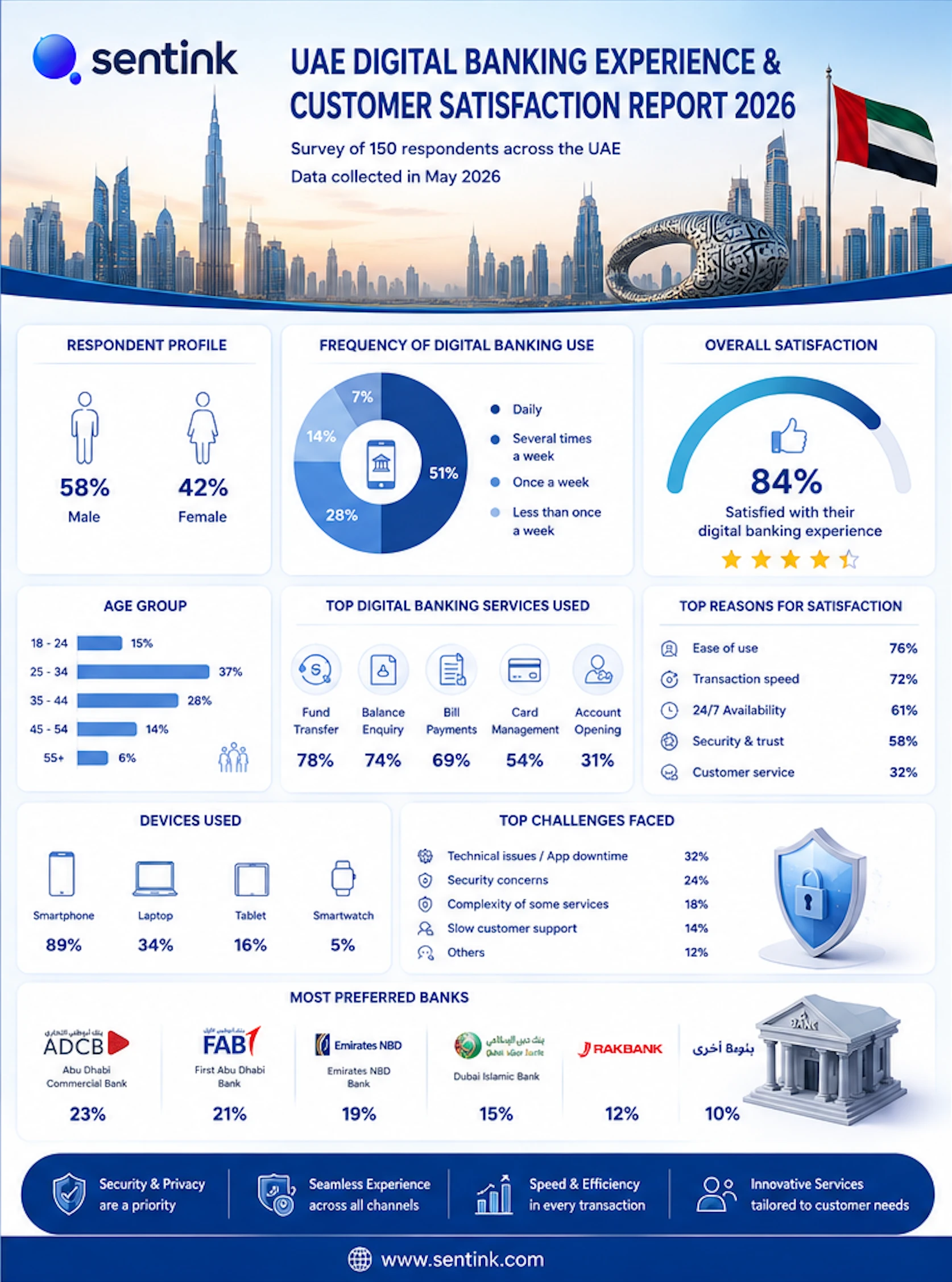
Survey infographic
A visual summary of respondent profiles, key metrics, and top findings from this study.
Frequently asked questions
What are the key findings on uae digital banking experience & customer satisfaction?
Dubai's digital banking users are a distinct, high-intensity segment requiring tailored engagement strategies. "Seamless and fast mobile app experience" settles the decision before the customer ever reaches a price comparison. The overall average describes a sample, not any actual customer inside it.
How do the results differ by segment?
This finding directly impacts customer retention and revenue generation by highlighting a significant engagement gap. It necessitates a differentiated digital product and marketing strategy to deepen relationships in Dubai while potentially re-evaluating the digital service model for the Northern Emirates to drive more consistent interaction and associated transaction opportunities.
What should leadership do first?
Launch targeted, high-frequency engagement campaigns for Dubai users, emphasizing instant transaction capabilities and personalized financial insights. Develop a 'lite' digital banking offering for Northern Emirates users, focusing on essential services and ease of access to encourage more regular usage.
How was this research conducted?
100 completed respondents.