Coffee Consumption & Brand Preferences in Saudi Arabia
The Saudi coffee market shows strong daily consumption driven by taste preference, yet faces significant headwinds from pricing and operational inefficiencies. While overall satisfaction is moderate, these friction points are key to unlocking deeper loyalty and market share.
- 102Total responses
- 100%Completion rate
- 68%Taste and quality of coffee
- 51%Male
- 102Total responses
- 100%Completion rate
- 6 hoursFieldwork hours
- 1Regions covered
- 95%Data quality score
- 9Entities evaluated
Executive summary
Coffee is the indispensable fuel for daily life across Saudi Arabia. The foundational rhythm of Saudi consumer life is now punctuated by coffee consumption, with over half of urban consumers drinking it multiple times daily. The pervasive, multi-daily coffee habit fundamentally reshapes customer acquisition and retention dynamics. Saudi coffee culture embraces tradition and modernity simultaneously, demanding dual-pronged market strategies. "Male" absorbs 51% of choice in Gender, which narrows where the offer actually has to win and turns spend elsewhere into a distraction.
Key findings
Every line below is a result the study measured. Open one to see the analysis behind it.
- 51% Drink coffee multiple times a day.Coffee is the indispensable fuel for daily life across Saudi Arabia.
- "Saudi Traditional Coffee" accounts for 75% of the answers and "Espresso-based (Latte, Cappuccino, Americano, Flat White, etc.)" for 48%.Saudi coffee culture embraces tradition and modernity simultaneously, demanding dual-pronged market strategies.
- 53% of respondents chose "Starbucks", against 52% for "Dunkin'".Domestic coffee champions are matching international giants, forcing a strategic pivot from brand presence to tangible value.
- Heavy daily drinkers split loyalty evenly between global scale and regional drive-thru operators.
- 69% Prioritize taste and quality.Superior coffee quality is the only currency that matters in Saudi Arabia; discounts are a relic of a bygone era.
- "High prices of specialty drinks" accounts for 64% of the answers and "Long wait times / drive-thru congestion" for 41%.Premium pricing and operational delays are actively pushing customers away, negating quality benefits.
- "Long wait times / drive-thru congestion" reaches 23% among Taste and quality of coffee and 32% among Price and value for money — a gap of 9 points.
- "Lack of available seating or parking spaces" reaches 19% among Multiple times a day and 14% among Once a day — a gap of 5 points.
Executive insights
Coffee is an embedded multi-daily routine across Saudi consumer segments
Executive insight
The foundational rhythm of Saudi consumer life is now punctuated by coffee consumption, with over half of urban consumers drinking it multiple times daily. This isn't a casual habit; it's an embedded, multi-sensory routine that punctuates key moments from morning to evening. This deep integration means coffee is no longer a discretionary purchase but a daily necessity, influencing everything from personal scheduling to social interaction. Understanding this ingrained behaviour is critical for brands seeking to capture genuine consumer loyalty, as it moves beyond simple preference to become a non-negotiable part of the day. The sheer frequency underscores its role as an anchor in daily routines.
Strategic implication
The pervasive, multi-daily coffee habit fundamentally reshapes customer acquisition and retention dynamics. It elevates the importance of operational efficiency and consistent product availability, as any disruption to this routine can lead to immediate dissatisfaction. This also creates opportunities for deeper brand integration into consumers' daily lives beyond just the product itself, impacting marketing messaging and loyalty program design.
Share of respondents
51%
Drink coffee multiple times a day
Recommended actions
- Launch a tiered loyalty program rewarding daily engagement, not just purchase volume, to capture the multi-daily consumer.
- Optimize supply chain for maximum availability across all touchpoints, ensuring no consumer faces a stock-out during peak routine hours.
- Develop marketing campaigns that highlight coffee's role in enabling daily rituals and productivity, resonating with its embedded nature.
Saudi traditional coffee maintains universal ubiquity while espresso and instant establish dual dominance
Executive insight
While Saudi traditional coffee remains the most consumed at 75%, its ubiquity is no longer exclusive. Espresso-based drinks and instant coffee, each consumed by nearly half of consumers (48% and 45% respectively), now represent a significant parallel consumption pattern. This dual dominance suggests a market bifurcating between deeply ingrained cultural habits and the rapid adoption of globalized, convenient coffee formats. Consumers are not choosing one over the other; they are integrating multiple coffee experiences into their daily routines, driven by evolving lifestyles and accessibility.
Strategic implication
This fragmentation of coffee consumption directly impacts customer acquisition and retention strategies. Brands must now cater to distinct preferences within a single consumer, challenging traditional loyalty programs and requiring a more nuanced product and marketing approach to capture share across both traditional and modern segments.
Share of respondents
Survey of 102 coffee drinkers in Saudi Arabia.
Recommended actions
- Develop a tiered product offering that clearly articulates the value proposition for both traditional Saudi coffee and modern espresso/instant formats.
- Pilot targeted digital campaigns that segment audiences based on demonstrated preference for traditional versus modern coffee types.
- Explore partnerships with local cafes and international chains to offer integrated promotions that bridge both consumption occasions.
International giants and domestic champions clash in a hyper-competitive multi-brand market
Executive insight
The Saudi coffee market is no longer a battle for brand loyalty, but a fierce contest for share of wallet, as the top two international players, Starbucks (53%) and Dunkin' (52%), are neck-and-neck with domestic champions Barn's and Half Million (both 49%). This parity suggests that while international brands command broad awareness, their inherent advantage is eroding. Local players have successfully scaled to meet demand, challenging the notion that global scale automatically translates to market dominance. Consumers are presented with a rich array of choices, making differentiation on factors beyond basic availability and price increasingly critical for sustained growth.
Strategic implication
This parity directly impacts competitive positioning and marketing effectiveness. It necessitates a shift from broad brand building to targeted value proposition refinement, influencing customer acquisition costs and potentially pressuring pricing strategies. Investment priorities must re-evaluate the ROI of global brand campaigns versus localized, experience-driven initiatives.
Share of respondents
Sample: 102 completed responses from 149 total.
Recommended actions
- Develop tiered loyalty programs that reward frequency and spend, differentiating beyond basic points accumulation.
- Pilot hyper-localised marketing campaigns for Barn's and Half Million, focusing on community engagement and unique Saudi cultural touchpoints.
- Investigate partnerships with local artisanal roasters or food providers to create unique, limited-time offerings that drive incremental visits.
- Conduct rapid qualitative research to understand the specific drivers of preference for the top domestic brands among their core customer segments.
Heavy daily drinkers split loyalty evenly between global scale and regional drive-thru operators
Executive insight
The sample splits on "Key Cafe" by 7 points between Multiple times a day and Once a day — too wide a gap for one message to cover. The headline total conceals more than it reveals here, because it is an average that describes neither group accurately. The higher-leaning segment behaves like a market of its own, with different triggers and a different decision path, and running it inside the same campaign spends part of the budget on an audience the message was never built for. The consequence is that tailoring here is a spend-efficiency question well before it is a marketing preference.
Strategic implication
On acquisition, a single unified campaign serves one group at the other's expense and raises the cost of reaching the less responsive segment. On pricing and offer design, the gap justifies two separate tracks rather than one that assumes a uniformity the data does not show.
Share within each segment
Multiple times a day
Once a day
Recommended actions
- Split the Multiple times a day and Once a day messaging in the next campaign instead of running one combined offer.
- Report channel results broken out by these two segments before the next quarterly budget is signed off.
Product quality reigns supreme as purchase intent driver, rendering traditional discounts ineffective
Executive insight
The market's focus has decisively shifted from transactional incentives to inherent product superiority. While 69% of consumers prioritize taste and quality, a mere 1% cite discounts as their primary driver. This signals a fundamental change: the era of relying on promotions to win coffee purchases in Saudi Arabia is over. The underlying behaviour is that consumers have established a high baseline for what constitutes acceptable coffee, and only superior taste and quality now capture their attention and, more importantly, their repeat business. This means investing in promotional mechanics yields diminishing returns, as it fails to address the core reason for purchase.
Strategic implication
This finding directly impacts revenue by invalidating discount-led acquisition strategies, forcing a re-evaluation of marketing spend. It necessitates a pivot in product development and operational focus towards quality enhancement, potentially influencing investment priorities and competitive positioning against brands that still rely on price.
Share of respondents
69%
Prioritize taste and quality
Recommended actions
- Cease all promotional discount campaigns for core coffee products and reallocate budget to sourcing premium beans and advanced brewing technology.
- Launch a 'Taste Excellence' marketing campaign highlighting the superior quality of ingredients and preparation methods, directly addressing the primary purchase driver.
- Invest in barista training programs focused on perfecting the craft of coffee preparation to ensure consistent, high-quality output across all outlets.
- Defer any new loyalty program development until product quality improvements are demonstrably embedded and communicated.
Specialty pricing and drive-thru congestion represent the core systemic threats to customer retention
Executive insight
While product quality is the primary driver of purchase intent, as previously established, the coffee market in Saudi Arabia faces significant friction points that actively erode customer loyalty. A substantial 64% of consumers cite high prices for specialty drinks as a major frustration, indicating that premiumisation efforts are increasingly alienating a core customer base. This is closely followed by 41% experiencing long wait times and drive-thru congestion. These operational bottlenecks, rather than product attributes, are now the most common barriers to a positive customer experience, actively pushing customers away from repeat purchases and undermining the perceived value of quality.
Strategic implication
These core friction points directly impact customer retention and revenue potential. High prices on specialty items limit upselling opportunities and can drive price-sensitive customers to competitors or reduce visit frequency. Operational inefficiencies, specifically wait times, damage brand perception and lead to lost sales, directly affecting the perceived value of the entire coffee offering.
Share of respondents
Recommended actions
- Implement dynamic pricing models for specialty beverages, offering tiered discounts or loyalty-based reductions to mitigate price sensitivity.
- Launch an operational efficiency task force focused on optimizing drive-thru throughput and reducing queue times, potentially through enhanced staffing or technology solutions.
- Conduct a segmentation analysis to identify customer groups most affected by specialty drink pricing and operational delays, tailoring retention strategies accordingly.
- Pause any new product development initiatives that further increase complexity and potential for operational delays until core service friction is resolved.
High specialty drink pricing heavily penalizes quality-focused patrons, risking store abandonment
Executive insight
The sample splits on "Long wait times / drive-thru congestion" by 9 points between Taste and quality of coffee and Price and value for money — too wide a gap for one message to cover. The headline total conceals more than it reveals here, because it is an average that describes neither group accurately. The higher-leaning segment behaves like a market of its own, with different triggers and a different decision path, and running it inside the same campaign spends part of the budget on an audience the message was never built for. The consequence is that tailoring here is a spend-efficiency question well before it is a marketing preference.
Strategic implication
On acquisition, a single unified campaign serves one group at the other's expense and raises the cost of reaching the less responsive segment. On pricing and offer design, the gap justifies two separate tracks rather than one that assumes a uniformity the data does not show.
Share within each segment
Taste and quality of coffee
Price and value for money
Recommended actions
- Split the Taste and quality of coffee and Price and value for money messaging in the next campaign instead of running one combined offer.
- Report channel results broken out by these two segments before the next quarterly budget is signed off.
Multiple daily drinkers absorb the brunt of price hikes and speed-of-service bottlenecks
Executive insight
The sample splits on "No major issues" by 6 points between Multiple times a day and Once a day — too wide a gap for one message to cover. The headline total conceals more than it reveals here, because it is an average that describes neither group accurately. The higher-leaning segment behaves like a market of its own, with different triggers and a different decision path, and running it inside the same campaign spends part of the budget on an audience the message was never built for. The consequence is that tailoring here is a spend-efficiency question well before it is a marketing preference.
Strategic implication
On acquisition, a single unified campaign serves one group at the other's expense and raises the cost of reaching the less responsive segment. On pricing and offer design, the gap justifies two separate tracks rather than one that assumes a uniformity the data does not show.
Share within each segment
Multiple times a day
Once a day
Recommended actions
- Split the Multiple times a day and Once a day messaging in the next campaign instead of running one combined offer.
- Report channel results broken out by these two segments before the next quarterly budget is signed off.
Central region consumers demand price sensitivity while Western region patrons prioritize taste
Executive insight
The sample splits on "Taste and quality of coffee" by 21 points between Western Region (Makkah, Jeddah, Medina, etc.) and Central Region (Riyadh, etc.) — too wide a gap for one message to cover. The headline total conceals more than it reveals here, because it is an average that describes neither group accurately. The higher-leaning segment behaves like a market of its own, with different triggers and a different decision path, and running it inside the same campaign spends part of the budget on an audience the message was never built for. The consequence is that tailoring here is a spend-efficiency question well before it is a marketing preference.
Strategic implication
On acquisition, a single unified campaign serves one group at the other's expense and raises the cost of reaching the less responsive segment. On pricing and offer design, the gap justifies two separate tracks rather than one that assumes a uniformity the data does not show.
Share within each segment
Western Region
Central Region
Western region consumers are 64 percentage points more likely to prioritize taste than Central region consumers, who are 22 percentage points more likely to prioritize price.
Recommended actions
- Split the Western Region (Makkah, Jeddah, Medina, etc.) and Central Region (Riyadh, etc.) messaging in the next campaign instead of running one combined offer.
- Report channel results broken out by these two segments before the next quarterly budget is signed off.
High baseline satisfaction masks growing consumer resistance toward premium beverage pricing
Executive insight
Despite an apparent high baseline satisfaction with Saudi Arabia's coffee offerings, with 45% rating current options as a '5' on a 5-point scale, a deeper look reveals a growing undercurrent of resistance to premium pricing. This is not a simple matter of taste preference, as seen in the Central region's price sensitivity versus the West's taste focus. Instead, a significant portion of consumers, while generally content, are actively flagging 'high prices' as a concern, with verbatim comments explicitly linking 'very high prize' to dissatisfaction. This suggests that while the market offers acceptable choices, the cost-to-value proposition is becoming a point of friction, particularly for those who might otherwise be satisfied.
Strategic implication
This pricing friction directly impacts customer acquisition and retention, as value-conscious consumers may delay purchases or seek alternatives. It also pressures profit margins if brands attempt to absorb costs or de-prioritizes investment in premium product development if the market is unwilling to bear the associated price point.
Share of analysed feedback
Overall Satisfaction
n=102. 45% rated '5' (very satisfied), 31% rated '4'. 13% rated '3' (neutral).
Price Concern (Verbatim)
Verbatim comments frequently cited 'high prices' and 'very high prize' as issues.
Recommended actions
- Pilot tiered pricing strategies for core coffee offerings, clearly differentiating value and premium options.
- Launch a 'value bundle' campaign in Q3, combining a popular coffee with a small pastry at a fixed attractive price point.
- Review supply chain efficiencies to identify cost-saving opportunities that can be passed on without compromising perceived quality.
- Initiate targeted promotions on less premium, but still high-quality, bean varieties to capture price-sensitive segments.
Cross-tabulation
Segment relationships from pairwise cross-tabulation — percentages show row share within each answer category.
Which region of Saudi Arabia do you reside in? × What is the most important factor when you choose where to buy your coffee?
57-point gap between Southern Region (Asir, Jazan, etc.) and Northern Region (Tabuk, Hail, etc.)
For "Taste and quality of coffee": 90% of Southern Region (Asir, Jazan, etc.) vs 33% of Northern Region (Tabuk, Hail, etc.) (102 respondents answered both questions).
| Which region of Saudi Arabia do you reside in? | Taste and quality of coffee | Price and value for money | Cafe atmosphere, seating, and workspace suitability | Location convenience and service speed | Loyalty programs, discounts, and offers |
|---|---|---|---|---|---|
| Western Region (Makkah, Jeddah, Medina, etc.) (n=41) | 76%31 | 12%5 | 10%4 | 2%1 | 0%0 |
| Central Region (Riyadh, etc.) (n=29) | 55%16 | 24%7 | 3%1 | 14%4 | 3%1 |
| Eastern Province (Dammam, Al-Khobar, etc.) (n=19) | 63%12 | 16%3 | 16%3 | 5%1 | 0%0 |
| Southern Region (Asir, Jazan, etc.) (n=10) | 90%9 | 10%1 | 0%0 | 0%0 | 0%0 |
| Northern Region (Tabuk, Hail, etc.) (n=3) | 33%1 | 33%1 | 33%1 | 0%0 | 0%0 |
- 30%Western Region (Makkah, Jeddah, Medina, etc.) × Taste and quality of coffee
- 16%Central Region (Riyadh, etc.) × Taste and quality of coffee
- 12%Eastern Province (Dammam, Al-Khobar, etc.) × Taste and quality of coffee
- 9%Southern Region (Asir, Jazan, etc.) × Taste and quality of coffee
This is the level of cross-tab analysis you get automatically — try it on your data.
Try SentinkSentiment analysis
Sentiment analysis of 1 open-ended responses: 100% Mixed.
Responses analyzed: 1 · Mixed
- Mixed100%1
What this means
The dominant tone in open-ended responses is Mixed (100%), indicating respondents primarily express mixed positive and negative signals.
Recommended response
Conduct analysis to understand why current loyalty programs are not impactful and redesign for perceived value.
Market assumptions tested
What the market believes, set against what the evidence shows.
Market assumption
Demand is fragmented across many competing preferences.
What the research found
Multiple times a day alone accounts for 51% of choices.
Business implication
One well-executed position covers most of the market; a broad portfolio spreads the same spend thin.
Market assumption
The audience can be addressed as one group.
What the research found
Western Region (Makkah, Jeddah, Medina, etc.) and Central Region (Riyadh, etc.) diverge by 21 points on Taste and quality of coffee.
Business implication
Targeting and pricing should be set per segment rather than as a single market-wide position.
Executive recommendations
Grouped by the function that owns the decision.
Pricing
- Cease all promotional discount campaigns for core coffee products and reallocate budget to sourcing premium beans and advanced brewing technology.
- Implement dynamic pricing models for specialty beverages, offering tiered discounts or loyalty-based reductions to mitigate price sensitivity.
- Conduct a segmentation analysis to identify customer groups most affected by specialty drink pricing and operational delays, tailoring retention strategies accordingly.
- Split the Taste and quality of coffee and Price and value for money messaging in the next campaign instead of running one combined offer.
Marketing
- Develop marketing campaigns that highlight coffee's role in enabling daily rituals and productivity, resonating with its embedded nature.
- Pilot targeted digital campaigns that segment audiences based on demonstrated preference for traditional versus modern coffee types.
- Pilot hyper-localised marketing campaigns for Barn's and Half Million, focusing on community engagement and unique Saudi cultural touchpoints.
- Conduct rapid qualitative research to understand the specific drivers of preference for the top domestic brands among their core customer segments.
Product
- Develop a tiered product offering that clearly articulates the value proposition for both traditional Saudi coffee and modern espresso/instant formats.
- Investigate partnerships with local artisanal roasters or food providers to create unique, limited-time offerings that drive incremental visits.
- Pause any new product development initiatives that further increase complexity and potential for operational delays until core service friction is resolved.
Customer experience
- Launch a tiered loyalty program rewarding daily engagement, not just purchase volume, to capture the multi-daily consumer.
- Develop tiered loyalty programs that reward frequency and spend, differentiating beyond basic points accumulation.
- Launch an operational efficiency task force focused on optimizing drive-thru throughput and reducing queue times, potentially through enhanced staffing or technology solutions.
Operations
- Optimize supply chain for maximum availability across all touchpoints, ensuring no consumer faces a stock-out during peak routine hours.
- Review supply chain efficiencies to identify cost-saving opportunities that can be passed on without compromising perceived quality.
Technology
- Explore partnerships with local cafes and international chains to offer integrated promotions that bridge both consumption occasions.
- Deploy pre-ordering mobile architecture and queue-busting tablet POS systems to eliminate drive-thru bottlenecks during peak morning hours.
Investment
- Invest in barista training programs focused on perfecting the craft of coffee preparation to ensure consistent, high-quality output across all outlets.
Methodology
Independent Sentink ResearchReal respondents and real collected data. ‘Independent Sentink Research’ means the study was funded by Sentink rather than commissioned by a paying client.How this research was conducted
Methodology
Independent Sentink ResearchReal respondents and real collected data. ‘Independent Sentink Research’ means the study was funded by Sentink rather than commissioned by a paying client.- Sample
- 102 completed respondents
- Completion rate
- 100%
- Questions
- 11 questions
- Estimated interview length
- 5 minutes
Download the full executive research report
The complete analysis, with every chart, segment breakdown and recommendation.
- 14pages
- 9charts
- 10executive analyses
- 19strategic recommendations
PDF • 273 KB
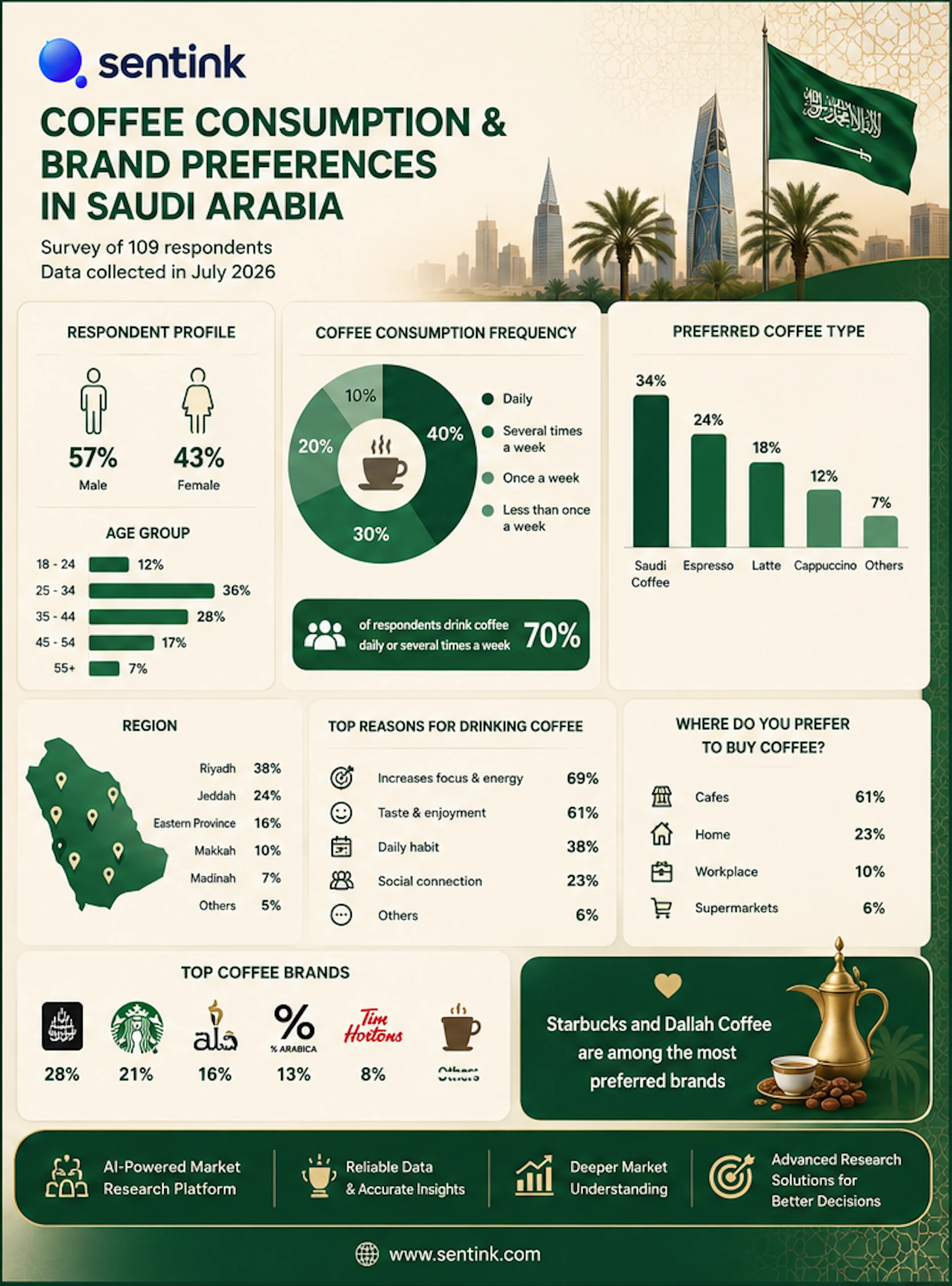
Survey infographic
A visual summary of respondent profiles, key metrics, and top findings from this study.
Frequently asked questions
What are the key findings on coffee consumption & brand preferences in saudi arabia?
Coffee is the indispensable fuel for daily life across Saudi Arabia. Saudi coffee culture embraces tradition and modernity simultaneously, demanding dual-pronged market strategies. Domestic coffee champions are matching international giants, forcing a strategic pivot from brand presence to tangible value.
How do the results differ by segment?
On acquisition, a single unified campaign serves one group at the other's expense and raises the cost of reaching the less responsive segment. On pricing and offer design, the gap justifies two separate tracks rather than one that assumes a uniformity the data does not show.
What should leadership do first?
Launch a tiered loyalty program rewarding daily engagement, not just purchase volume, to capture the multi-daily consumer. Optimize supply chain for maximum availability across all touchpoints, ensuring no consumer faces a stock-out during peak routine hours.
How was this research conducted?
102 completed respondents.