
Email Services Survey
A recent Microsoft service disruption significantly impacted productivity for many users. This event has led to increased skepticism about reliance on single technology vendors and revealed gaps in organizational preparedness.
- 471Total responses
- 100%Completion rate
- 69%Full-time employee
- 60%Company office
- 471Total responses
- 100%Completion rate
- 5 hoursFieldwork hours
- 7Regions covered
- 91%Data quality score
- 16Entities evaluated
Executive summary
Email delays and Outlook outages hit over half of workers during the Microsoft IT disruption. Email delays and Outlook being down caused the biggest problems for workers during the Microsoft outage. When core communication tools fail, widespread workplace disruptions occur. Most workers experienced work disruptions due to the IT outage, impacting their ability to do their jobs.
Key findings
Every line below is a result the study measured. Open one to see the analysis behind it.
- 56% of respondents chose "Email delivery delayed", against 53% for "Outlook/work email unavailable".Email delays and Outlook outages hit over half of workers during the Microsoft IT disruption.
- 43% workers faced moderate disruption to their normal daily duties.Most workers experienced work disruptions due to the IT outage, impacting their ability to do their jobs.
- "Neutral" reaches 20% among Frustration and 29% among Confusion — a gap of 9 points.
- "No, not at all" accounts for 41% of the answers and "Yes, a little" for 37%.A majority of employees found the IT outage frustrating, but many also used the time for breaks and colleague interaction.
- 66% of respondents chose "WhatsApp", against 39% for "Phone calls/SMS".When corporate email failed, 66% of employees turned to WhatsApp to communicate for work.
- "30–60 minutes" reaches 34% among Türkiye and 25% among Germany — a gap of 9 points.
- System outages cause confusion but can also foster unexpected social connections and resilience among workers.
Findings in detail
Email delays and Outlook unavailability caused the most widespread workplace problems
What we found
Email delays and Outlook being down caused the biggest problems for workers during the Microsoft outage. More than half of those surveyed, 56%, said their email was delayed. Over half, 53%, found Outlook itself unavailable. These issues were far more common than problems with Teams or other services.
Why it matters
When core communication tools fail, widespread workplace disruptions occur. This highlights the critical need for IT teams to prepare for and quickly resolve outages affecting email and collaboration platforms.
Share of respondents
Based on 451 workers surveyed across six countries.
What to do
- Develop and test backup communication plans for email and calendar functions.
- Train IT support staff on rapid response protocols for email and Outlook outages.
- Identify and prioritize critical business processes dependent on Microsoft services for resilience planning.
43% of workers faced moderate disruption to their normal daily duties
What we found
Nearly half of workers, 43%, said the IT outage moderately disrupted their daily tasks. Another 33% faced significant disruption. This means most people struggled to do their jobs as usual, going beyond minor annoyances to real work slowdowns.
Why it matters
Widespread disruption slows down entire teams and projects. This impacts productivity and can lead to missed deadlines, affecting overall business goals and employee morale.
Share of respondents
43%
workers faced moderate disruption to their normal daily duties
What to do
- Develop clear communication plans for IT outages that inform staff of expected impact and duration.
- Stockpile essential offline workarounds for common tasks that rely on email or cloud services.
- Train staff on how to use backup communication channels during service disruptions.
Frustrated workers felt stressed while indifferent staff reported no stress at all
What we found
Frustration and Confusion answer differently on "Neutral": 20% against 29%. So the overall figure hides a difference between the two groups, and reading it alone can give a misleading picture. The gap describes what participants in each group said, and does not prove why.
Why it matters
The gap means that what suits Frustration may not suit Confusion to the same degree. Any step built on this result needs to take both groups into account.
Share within each segment
Frustration
Confusion
What to do
- Show the Frustration and Confusion results separately when discussing "Neutral", not only the overall figure.
- Check how many participants are in each group before relying on the gap, and measure again if one group is small.
41% of employees did not enjoy any part of the service disruption
What we found
While many workers felt stressed during the IT outage, 41% of employees reported they did not enjoy any part of the service disruption. Another 37% found some small enjoyment, and 14% definitely did. During the downtime, 35% of workers chatted with colleagues face-to-face, and 26% took extra breaks or went for a walk.
Why it matters
The IT outage caused significant frustration for many. Understanding that some employees found ways to connect or de-stress shows a need for better support and communication during future disruptions.
Share of respondents
Based on a survey of 451 employees across six countries.
What to do
- Develop clear communication plans for IT disruptions, explaining expected downtime and support channels.
- Train IT support staff on empathetic communication during outages.
- Offer employees flexible break options during system-wide issues.
- Encourage informal colleague interaction during disruptions to maintain morale.
Two-thirds of employees switched to WhatsApp when corporate email failed
What we found
When Microsoft services failed, most employees found a way to keep working. Two-thirds, or 299 out of 451 workers, used WhatsApp for work messages. This was the most common alternative. Phone calls and SMS were used by 39% of workers, and 31% used personal email like Gmail.
Why it matters
Reliable internal communication tools are vital. When primary systems fail, employees quickly adopt familiar, accessible tools, impacting productivity and data security.
Share of respondents
What to do
- Assess and approve popular messaging apps like WhatsApp for business use during outages.
- Develop clear guidelines for employees on using personal or alternative communication tools for work.
- Train IT teams on how to quickly restore essential communication services or enable approved alternatives.
Workers in Türkiye lost far less time than those in South Africa
What we found
Türkiye and Germany answer differently on "None": 0% against 15%. So the overall figure hides a difference between the two groups, and reading it alone can give a misleading picture. The gap describes what participants in each group said, and does not prove why.
Why it matters
The gap means that what suits Türkiye may not suit Germany to the same degree. Any step built on this result needs to take both groups into account.
Share within each segment
Türkiye
Germany
What to do
- Show the Türkiye and Germany results separately when discussing "None", not only the overall figure.
- Check how many participants are in each group before relying on the gap, and measure again if one group is small.
Workers described a mix of sudden confusion office social breaks and resilience
What we found
When email services failed, workers felt sudden confusion about whether their own systems were broken. However, this quickly turned into an unplanned social break for many, with colleagues gathering to share the experience. Some teams showed resilience by using personal chat groups to handle urgent tasks.
Why it matters
Downtime can disrupt operations and create uncertainty. However, it also presents an opportunity for informal team bonding and highlights the need for adaptable communication methods beyond primary systems.
Verbatim feedback
Everyone suddenly started looking at each other, wondering if the problem was with their computers or if the whole world had stopped working. It was like we had travelled back 20 years in time!
When Microsoft went down, the whole office suddenly became very social. People crowded around the coffee machine, and someone shouted "Is it down for you too?" as if they had made a great discovery. It felt loke an unplanned break for everyone.
So many people were so happy because it happened on a Friday which is deemed as a day to not “work”at all
Staff used personal WhatsApp groups to coordinate urgent payroll queries while email was offline, showing unexpected resilience.
What to do
- Prepare backup communication channels for critical tasks during outages.
- Train staff on using alternative tools for urgent queries when primary systems fail.
- Acknowledge and support informal communication networks that emerge during disruptions.
Cross-tabulation
Segment relationships from pairwise cross-tabulation — percentages show row share within each answer category.
Q01. Country of employment × Q09. Approximately how many employees work in your organization worldwide?
100-point gap between 4 and United States
For "1–9": 100% of 4 vs 0% of United States (471 respondents answered both questions).
| Q01. Country of employment | 50–249 | 10–49 | 250–999 | 1,000–4,999 | 5,000+ |
|---|---|---|---|---|---|
| Türkiye (n=82) | 21%17 | 20%16 | 23%19 | 12%10 | 9%7 |
| UAE (n=82) | 23%19 | 21%17 | 18%15 | 16%13 | 16%13 |
| India (n=81) | 20%16 | 14%11 | 26%21 | 16%13 | 19%15 |
| South Africa (n=81) | 23%19 | 20%16 | 19%15 | 15%12 | 14%11 |
| Germany (n=80) | 40%32 | 18%14 | 11%9 | 16%13 | 9%7 |
| United Kingdom (n=56) | 21%12 | 21%12 | 14%8 | 13%7 | 13%7 |
- 7%Germany × 50–249
- 4%India × 250–999
- 4%Türkiye × 250–999
- 4%UAE × 50–249
This is the level of cross-tab analysis you get automatically — try it on your data.
Try SentinkSentiment analysis
Sentiment analysis of 72 open-ended responses: 53% Neutral, 32% Positive, 8% Mixed, 7% Negative.
Responses analyzed: 72 · Neutral
- Neutral53%38
- Positive32%23
- Mixed8%6
- Negative7%5
What this means
The dominant tone in open-ended responses is Neutral (53%), indicating respondents primarily express neutral or non-polarized attitudes.
Recommended response
Conduct training for employees on how to utilize alternative communication methods during disruptions.
Sample themes from open-ended answers
- Positive
A direct affirmative confirmation reflecting agreement and cooperative intent.
- Positive
First of all iam confidently about my work So check the problem and search alternatives
Demonstrates high self-assurance and problem-solving readiness, prioritizing systematic troubleshooting and exploring alternative approaches when facing professional hurdles.
Market assumptions tested
What the market believes, set against what the evidence shows.
Market assumption
Demand is fragmented across many competing preferences.
What the research found
Email delivery delayed alone accounts for 56% of choices.
Business implication
One well-executed position covers most of the market; a broad portfolio spreads the same spend thin.
Executive recommendations
Grouped by the function that owns the decision.
Marketing
- Develop and test backup communication plans for email and calendar functions.
- Develop clear communication plans for IT outages that inform staff of expected impact and duration.
- Train staff on how to use backup communication channels during service disruptions.
- Develop clear communication plans for IT disruptions, explaining expected downtime and support channels.
Customer experience
- Train IT support staff on rapid response protocols for email and Outlook outages.
- Identify and prioritize critical business processes dependent on Microsoft services for resilience planning.
- Stockpile essential offline workarounds for common tasks that rely on email or cloud services.
- Train staff on using alternative tools for urgent queries when primary systems fail.
Technology
- Offer employees flexible break options during system-wide issues.
Strategic priorities
- Show the Frustration and Confusion results separately when discussing "Neutral", not only the overall figure.
- Check how many participants are in each group before relying on the gap, and measure again if one group is small.
- Encourage informal colleague interaction during disruptions to maintain morale.
- Show the Türkiye and Germany results separately when discussing "None", not only the overall figure.
Methodology
Independent Sentink ResearchReal respondents and real collected data. ‘Independent Sentink Research’ means the study was funded by Sentink rather than commissioned by a paying client.How this research was conducted
Methodology
Independent Sentink ResearchReal respondents and real collected data. ‘Independent Sentink Research’ means the study was funded by Sentink rather than commissioned by a paying client.- Sample
- 471 completed respondents
- Completion rate
- 100%
- Questions
- 37 questions
- Estimated interview length
- 10 minutes
Download the full executive research report
The complete analysis, with every chart, segment breakdown and recommendation.
- 10pages
- 6charts
- 7executive analyses
- 13strategic recommendations
PDF • 161 KB
Survey infographic
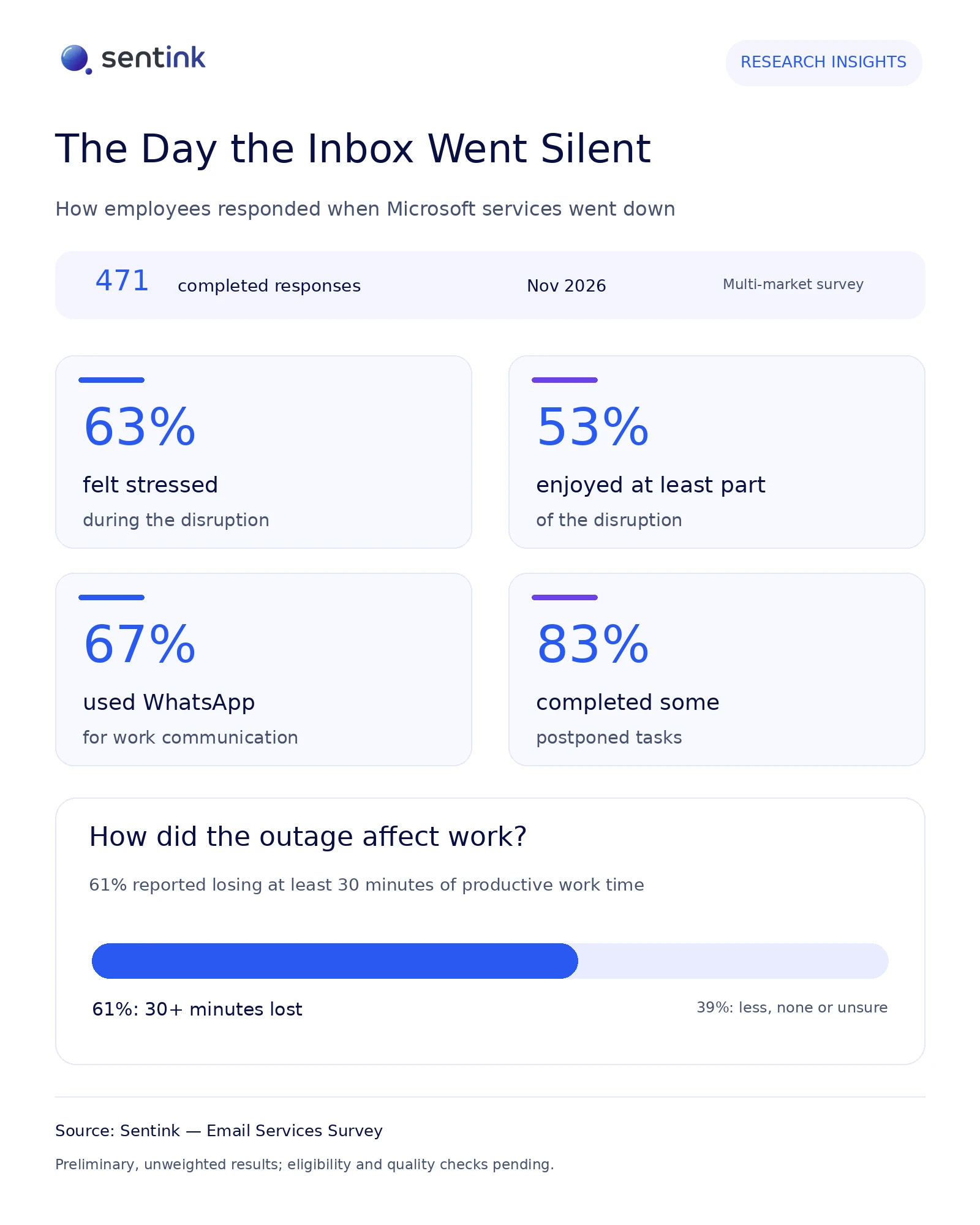
A visual summary of respondent profiles, key metrics, and top findings from this study.
Frequently asked questions
What are the key findings on email services?
Email delays and Outlook outages hit over half of workers during the Microsoft IT disruption. Most workers experienced work disruptions due to the IT outage, impacting their ability to do their jobs. Frustration and Confusion do not answer the same way: 9 percentage points apart on "Neutral".
How do the results differ by segment?
The gap means that what suits Frustration may not suit Confusion to the same degree. Any step built on this result needs to take both groups into account.
What should leadership do first?
Develop and test backup communication plans for email and calendar functions. Train IT support staff on rapid response protocols for email and Outlook outages.
How was this research conducted?
471 completed respondents.