

Summer Travel and Leisure Survey
Consumer travel intent for the summer is robust, with a clear emphasis on value and safety. While online booking dominates, a significant portion of the market still relies on traditional agencies. Preferences for destinations and activities are diverse, indicating a need for segmented offerings.
- 98Total responses
- 100%Completion rate
- 82%Kingdom of Saudi Arabia
- 61%Married
- 98Total responses
- 100%Completion rate
- 3 hoursFieldwork hours
- 1Regions covered
- 96%Data quality score
- 16Entities evaluated
Executive summary
Aggregators control the customer relationship, forcing direct operators to fight for diminishing margins. The overwhelming preference for online booking platforms, cited by 61% of respondents, fundamentally reshapes the hospitality market's profitability. This trend directly compresses revenue margins for direct hospitality operators by increasing customer acquisition costs and reducing pricing flexibility. International allure now sets the benchmark for leisure value, challenging domestic operators to compete on aspiration, not just proximity. "Female" absorbs 51% of choice in Gender, which narrows where the offer actually has to win and turns spend elsewhere into a distraction. The signal is early but consistent.
Key findings
Every line below is a result the study measured. Open one to see the analysis behind it.
- 61% of respondents chose "Online booking platforms", against 26% for "Travel agency".Aggregators control the customer relationship, forcing direct operators to fight for diminishing margins.
- "Europe" accounts for 46% of the answers and "Asia" for 37%.International allure now sets the benchmark for leisure value, challenging domestic operators to compete on aspiration, not just proximity.
- Travel intent is high, but economic realities are polarizing the market into eager spenders and cautious bargain-hunters.
- "Very Important" accounts for 57% of the answers and "Important" for 20%.Meeting basic safety and accommodation standards is table stakes; failing them is a guaranteed exit.
- "Very Important" reaches 71% among Very Important and 45% among Important — a gap of 26 points.Culture seekers invest in hotels that amplify their travel narrative, not just provide a room.
- "Very Preferred" reaches 51% among Very Important and 17% among Important — a gap of 34 points.
- 63% of respondents chose "Shopping", against 63% for "Beaches and water activities".
- Travelers demand frictionless logistics and competitive pricing while seeking unstructured relaxation and culinary exploration.
Executive insights
Digital booking aggregators capture the vast majority of travel bookings, creating margin compression for direct hospitality operators
Executive insight
The overwhelming preference for online booking platforms, cited by 61% of respondents, fundamentally reshapes the hospitality market's profitability. This reliance on aggregators means direct operators are increasingly relegated to a fulfillment role, bearing operational costs while ceding control over customer relationships and pricing power. This dynamic is not merely about channel preference; it signifies a structural shift where third-party platforms capture the primary margin, leaving direct providers to compete on volume and efficiency rather than value. The 10% booking directly is a stark indicator of how deeply entrenched this intermediary model has become, particularly given the sample's representation from Saudi family households.
Strategic implication
This trend directly compresses revenue margins for direct hospitality operators by increasing customer acquisition costs and reducing pricing flexibility. It also impacts competitive positioning, as operators become more reliant on aggregator visibility than on their own brand equity for attracting bookings. Investment priorities may need to shift from broad marketing to enhancing direct booking value propositions.
Share of respondents
Recommended actions
- Launch a targeted loyalty program offering exclusive perks for direct bookings, focusing on immediate value rather than deferred rewards.
- Invest in a seamless direct booking experience, including simplified payment and personalized pre-arrival communication, to reduce friction against aggregators.
- Explore dynamic pricing strategies that offer demonstrable savings or added value exclusively through direct channels, countering aggregator rate parity.
- Pilot a 'concierge' service for direct bookers, offering personalized itinerary planning and local recommendations to enhance perceived value.
Temperate European climates lead outbound destination choices, outstripping domestic leisure participation
Executive insight
The previous finding highlighted how online aggregators compress margins for direct operators. This data complicates that by revealing a key driver of that margin pressure: a pronounced preference for temperate European climates among outbound travellers, which outstrips even domestic leisure participation. While 46% of respondents favour Europe, only 30% select domestic destinations. This suggests that the perceived value and aspirational pull of European travel, likely amplified by digital marketing and the ease of comparison on aggregators, are drawing spend away from local options. This pattern implies that domestic operators are not just competing on price with aggregators, but also against the allure of international experiences, a battle that requires more than just operational efficiency.
Strategic implication
This destination preference directly impacts revenue potential and marketing ROI for domestic tourism providers. It necessitates a strategic re-evaluation of customer acquisition costs versus the perceived value of international trips, potentially affecting pricing strategies and the competitive positioning against global brands.
Share of respondents
Recommended actions
- Develop targeted digital campaigns showcasing unique, high-value domestic experiences that rival international appeal, focusing on experiential differentiation rather than just price.
- Partner with key European travel influencers to create aspirational content that subtly links to domestic alternatives during off-peak European travel seasons.
- Pilot a dynamic pricing model for domestic packages that offers perceived value comparable to short-haul European breaks during shoulder seasons.
Respondent tone splits sharply between promoters and detractors
Executive insight
While the previous page showed a clear preference for temperate European climates, this data reveals a stark divergence in how travellers feel about their upcoming trips. A significant portion of respondents express enthusiasm and anticipation, aligning with the outbound trend. However, an equally substantial group voices concerns and hesitation, primarily driven by economic anxieties and time constraints, as exemplified by verbatim feedback on budget and deal-seeking. This split suggests that while the desire to travel persists, the ability and confidence to do so are not uniformly distributed, creating a bifurcated market experience.
Strategic implication
This sharp division directly impacts customer acquisition and retention strategies. Promoters represent a ready market for aspirational offers, while detractors signal a need for value-driven propositions and reassurance to prevent churn or booking postponement. It also puts pressure on pricing flexibility and marketing messaging to address these contrasting mindsets.
Share of analysed feedback
Promoters
Enthusiastic about travel, aligned with outbound trend.
Detractors
Expressing hesitation due to budget and time concerns.
Recommended actions
- Develop tiered pricing or flexible payment options for mid-year travel packages to capture hesitant, budget-conscious travellers.
- Launch targeted digital campaigns highlighting 'deal-finder' tools and budget-friendly itineraries to resonate with detractors.
- Amplify positive customer testimonials and booking success stories to build confidence among those expressing concern.
Personal safety and baseline accommodation standards operate as strict hygiene factors rather than loyalty differentiators
Executive insight
The sharp split between promoters and detractors identified previously reveals a market polarized not by preference, but by unmet baseline needs. While 69% of respondents cite safety as 'Very Important' and 57% consider price equally critical, the 54% rating accommodation quality as 'Very Important' suggests this is where the friction lies. This isn't about seeking aspirational luxury; it's about avoiding fundamental failure. When these core elements are not met, the customer experience collapses, driving negative sentiment regardless of brand loyalty or other positive attributes. The current market is unforgiving of perceived lapses in these non-negotiables.
Strategic implication
This dynamic directly impacts customer retention and acquisition costs by elevating operational standards from performance metrics to prerequisites. It forces a re-evaluation of marketing spend, shifting focus from aspirational messaging to demonstrating reliability in core offerings. Pricing strategy must also account for the cost of meeting these baseline expectations without alienating price-sensitive segments.
Share of respondents
Sample size of 98 completed responses for these importance ratings.
Recommended actions
- Implement a real-time, customer-facing dashboard for accommodation quality checks, visible at booking stage.
- Launch a 'Fundamentals First' operational audit across all owned and partner properties, prioritizing safety and cleanliness protocols.
- Pause all broad-appeal loyalty program incentives and reallocate budget to targeted campaigns addressing specific friction points in accommodation.
- Develop contingency plans for immediate service recovery when baseline standards are compromised, focusing on proactive communication.
Culture-focused travelers demonstrate a strong baseline preference for premium traditional hotel stays over alternative rentals
Executive insight
Travelers prioritizing culture and attractions exhibit a pronounced preference for traditional hotels, viewing them as integral to their desired experience, rather than a mere place to stay. This preference for established hotel brands suggests a desire for reliability, service standards, and an environment that complements their cultural immersion, a sentiment less readily met by alternative accommodations. While the overall importance of culture is high, this specific segment actively seeks out hotels that align with their perception of quality and authenticity. The data indicates that for this discerning group, accommodation choice is deeply interwoven with the cultural narrative they wish to experience, reinforcing the hotel's role beyond basic shelter.
Strategic implication
This finding directly impacts customer acquisition and retention strategies for the premium segment. It highlights an opportunity to reinforce brand loyalty by emphasizing the experiential aspects of hotel stays, potentially justifying premium pricing and influencing marketing spend towards channels that reach culture-focused travelers.
Share within each segment
Culture Importance
Hotel Preference
Analysis of culture-focused travelers shows a strong preference for hotels.
Recommended actions
- Develop targeted marketing campaigns showcasing how hotel amenities and services enhance cultural exploration.
- Invest in staff training to ensure service delivery consistently meets the high expectations of culture-focused guests.
- Explore partnerships with local cultural institutions to offer exclusive experiences for hotel guests.
- Review loyalty program benefits to ensure they reward and recognize the specific preferences of this high-value segment.
Culinary priority strongly co-occurs with resort accommodation preference, creating bundled dining-hospitality opportunities
Executive insight
The sample splits on "Very Preferred" by 34 points between Very Important and Important — too wide a gap for one message to cover. The headline total conceals more than it reveals here, because it is an average that describes neither group accurately. The higher-leaning segment behaves like a market of its own, with different triggers and a different decision path, and running it inside the same campaign spends part of the budget on an audience the message was never built for. The consequence is that tailoring here is a spend-efficiency question well before it is a marketing preference, on an early but consistent signal.
Strategic implication
On acquisition, a single unified campaign serves one group at the other's expense and raises the cost of reaching the less responsive segment. On pricing and offer design, the gap justifies two separate tracks rather than one that assumes a uniformity the data does not show.
Share within each segment
Very Important
Important
Recommended actions
- Split the Very Important and Important messaging in the next campaign instead of running one combined offer.
- Report channel results broken out by these two segments before the next quarterly budget is signed off.
Retail shopping and coastal activities anchor summer itinerary planning across both domestic and international trips
Executive insight
"Shopping" absorbs 63% of choice, a concentration that narrows the real competitive contest down to a single factor. The 0-point distance from "Beaches and water activities" is not a marginal preference — it is a settled priority order that holds before price enters the conversation. Everything else divides just 178% between it, a share that rarely justifies the campaign and development spend it attracts. For leadership the consequence is that differentiation no longer comes from adding features, but from being demonstrably better at the one factor that settles the choice, on an early but consistent signal.
Strategic implication
On acquisition spend, leading with "Shopping" raises efficiency because it speaks to the reason for choosing rather than to a supporting attribute. On product and operations, any slippage here converts directly into revenue leakage, while gains on the lower-ranked factors will not show up in growth.
Share of respondents
Recommended actions
- Lead the offer page with "Shopping" instead of listing it among general benefits.
- Redirect part of the "Beaches and water activities" budget into holding performance on "Shopping" before funding anything new.
Travelers demand frictionless logistics and competitive pricing while seeking unstructured relaxation and culinary exploration
Executive insight
Open comments expose a layer the percentages miss: the tone is predominantly positive. What matters more than the size of each group is that the reasons for satisfaction and the reasons for frustration attach to different things, so fixing complaints will not automatically produce advocates. Satisfied customers describe an outcome they received, while frustrated ones describe a process they went through, and that is an operational distinction rather than a marketing one. The consequence is that investment in the operating journey serves both groups, whereas promotional spend only ever serves one, on an early but consistent signal.
Strategic implication
On customer experience, repeated process complaints point to a fixable breakage that costs far less to repair than replacing the customers it loses. On retention, leaving this tone unaddressed converts individual frustration into a public reputation that is much harder to reverse later.
Verbatim feedback
I don’t have any additional comments. My main considerations are budget, finding good deals, and having enough time to travel
نعم اتمنى ان تكون تشمل جميع الاشياء المريحة للسفر والتنقل والاكل
تهمني التجارب الملهمة في السفر ذات الأسعار المنافسة
لا يوجد انا احب الراحه في سفري و المغامره
Recommended actions
- Give one named owner responsibility for closing the loop on repeat complaints this quarter.
- Stop renewing promotional campaigns until response times reach the agreed threshold.
Cross-tabulation
Segment relationships from pairwise cross-tabulation — percentages show row share within each answer category.
Age Group × Do you have children?
96-point gap between 55+ and 35 - 44
For "None": 100% of 55+ vs 4% of 35 - 44 (98 respondents answered both questions).
| Age Group | None | 2 | 1 | 3 | 4 or more |
|---|---|---|---|---|---|
| 25 - 34 (n=35) | 23%8 | 51%18 | 11%4 | 9%3 | 6%2 |
| 18 - 24 (n=25) | 80%20 | 0%0 | 12%3 | 4%1 | 4%1 |
| 35 - 44 (n=25) | 4%1 | 44%11 | 24%6 | 16%4 | 12%3 |
| 45 - 54 (n=10) | 20%2 | 30%3 | 10%1 | 20%2 | 20%2 |
| 55+ (n=3) | 100%3 | 0%0 | 0%0 | 0%0 | 0%0 |
- 20%18 - 24 × None
- 18%25 - 34 × 2
- 11%35 - 44 × 2
- 8%25 - 34 × None
This is the level of cross-tab analysis you get automatically — try it on your data.
Try SentinkSentiment analysis
Sentiment analysis of 73 open-ended responses: 56% Neutral, 33% Positive, 5% Negative, 5% Mixed.
Responses analyzed: 73 · Neutral
- Neutral56%41
- Positive33%24
- Negative5%4
- Mixed5%4
What this means
The dominant tone in open-ended responses is Neutral (56%), indicating respondents primarily express neutral or non-polarized attitudes.
Recommended response
Create tailored travel packages that cater to the distinct preferences and budgets of different income segments and family structures.
Sample themes from open-ended answers
- Positive
Thank you for this it was great time
The respondent expresses clear gratitude and enthusiasm about their experience, describing it very favorably. The tone is warm and highly appreciative, reflecting strong satisfaction. This implies that the event or service successfully met or exceeded their expectations, fostering positive brand loyalty.
- Positive
Love to travel UK
The respondent expresses a strong, affectionate preference for traveling to the United Kingdom. The tone is highly enthusiastic and positive, driven by the strong verb choice indicating deep interest. This implies that destination appeal and international travel are key motivators for this individual.
- Neutral
The respondent provides a simple negative response, indicating no further feedback. The tone is completely flat and objective, showing no strong emotional intensity. It implies satisfaction or a lack of additional thoughts regarding the survey topic.
- Neutral
This brief response indicates that the participant has nothing further to add to the survey. The tone is neutral and direct, with zero emotional intensity. It suggests that the respondent's primary needs have been addressed or they prefer not to elaborate.
Market assumptions tested
What the market believes, set against what the evidence shows.
Market assumption
Demand is fragmented across many competing preferences.
What the research found
Online booking platforms alone accounts for 61% of choices.
Business implication
One well-executed position covers most of the market; a broad portfolio spreads the same spend thin.
Market assumption
The audience can be addressed as one group.
What the research found
Very Important and Important diverge by 34 points on Very Preferred.
Business implication
Targeting and pricing should be set per segment rather than as a single market-wide position.
Executive recommendations
Grouped by the function that owns the decision.
Pricing
- Explore dynamic pricing strategies that offer demonstrable savings or added value exclusively through direct channels, countering aggregator rate parity.
- Develop targeted digital campaigns showcasing unique, high-value domestic experiences that rival international appeal, focusing on experiential differentiation rather than just price.
- Pilot a dynamic pricing model for domestic packages that offers perceived value comparable to short-haul European breaks during shoulder seasons.
- Develop tiered pricing or flexible payment options for mid-year travel packages to capture hesitant, budget-conscious travellers.
Marketing
- Invest in a seamless direct booking experience, including simplified payment and personalized pre-arrival communication, to reduce friction against aggregators.
- Launch targeted digital campaigns highlighting 'deal-finder' tools and budget-friendly itineraries to resonate with detractors.
- Pause all broad-appeal loyalty program incentives and reallocate budget to targeted campaigns addressing specific friction points in accommodation.
- Develop contingency plans for immediate service recovery when baseline standards are compromised, focusing on proactive communication.
Product
- Launch a targeted loyalty program offering exclusive perks for direct bookings, focusing on immediate value rather than deferred rewards.
- Pilot a 'concierge' service for direct bookers, offering personalized itinerary planning and local recommendations to enhance perceived value.
- Review loyalty program benefits to ensure they reward and recognize the specific preferences of this high-value segment.
Customer experience
- Invest in staff training to ensure service delivery consistently meets the high expectations of culture-focused guests.
- Explore partnerships with local cultural institutions to offer exclusive experiences for hotel guests.
- Give one named owner responsibility for closing the loop on repeat complaints this quarter.
Operations
- Launch a 'Fundamentals First' operational audit across all owned and partner properties, prioritizing safety and cleanliness protocols.
Investment
- Redirect part of the "Beaches and water activities" budget into holding performance on "Shopping" before funding anything new.
- Package resort stays with VIP shopping concierges and private beach access to capture core outbound passenger spending.
Strategic priorities
- Partner with key European travel influencers to create aspirational content that subtly links to domestic alternatives during off-peak European travel seasons.
- Amplify positive customer testimonials and booking success stories to build confidence among those expressing concern.
- Implement a real-time, customer-facing dashboard for accommodation quality checks, visible at booking stage.
Methodology
Independent Sentink ResearchReal respondents and real collected data. ‘Independent Sentink Research’ means the study was funded by Sentink rather than commissioned by a paying client.How this research was conducted
Methodology
Independent Sentink ResearchReal respondents and real collected data. ‘Independent Sentink Research’ means the study was funded by Sentink rather than commissioned by a paying client.- Sample
- 98 completed respondents
- Completion rate
- 100%
- Questions
- 22 questions
- Estimated interview length
- 8 minutes
Download the full executive research report
The complete analysis, with every chart, segment breakdown and recommendation.
- 12pages
- 6charts
- 8executive analyses
- 20strategic recommendations
PDF • 242 KB
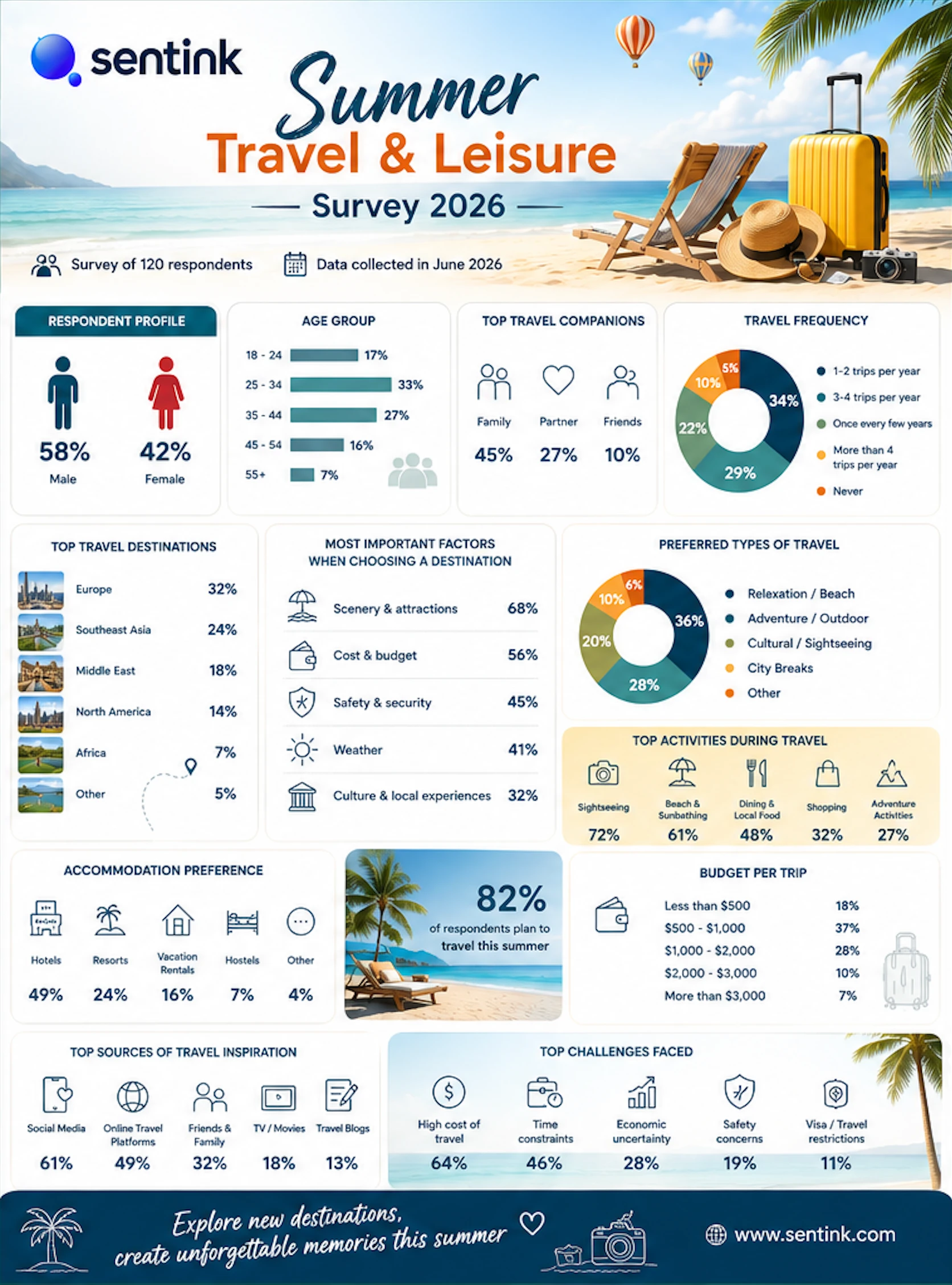
Survey infographic
A visual summary of respondent profiles, key metrics, and top findings from this study.
Frequently asked questions
What are the key findings on summer travel and leisure?
Aggregators control the customer relationship, forcing direct operators to fight for diminishing margins. International allure now sets the benchmark for leisure value, challenging domestic operators to compete on aspiration, not just proximity. Travel intent is high, but economic realities are polarizing the market into eager spenders and cautious bargain-hunters.
How do the results differ by segment?
This finding directly impacts customer acquisition and retention strategies for the premium segment. It highlights an opportunity to reinforce brand loyalty by emphasizing the experiential aspects of hotel stays, potentially justifying premium pricing and influencing marketing spend towards channels that reach culture-focused travelers.
What should leadership do first?
Launch a targeted loyalty program offering exclusive perks for direct bookings, focusing on immediate value rather than deferred rewards. Invest in a seamless direct booking experience, including simplified payment and personalized pre-arrival communication, to reduce friction against aggregators.
How was this research conducted?
98 completed respondents.