

Gold & Investment Trends Survey
Gold's perception has shifted from a speculative asset to a primary savings instrument, with a significant portion of the market now favoring it over traditional banking. This trend is underpinned by a strong interest in wealth preservation and accumulation.
- 113Total responses
- 100%Completion rate
- 70%
- 56%Very interested
- 113Total responses
- 100%Completion rate
- 5 hoursFieldwork hours
- 2Regions covered
- 96%Data quality score
- 16Entities evaluated
Executive summary
Physical gold is now the foundational pillar for regional investment portfolios, not a speculative add-on. The robust representation of middle-to-upper income individuals across KSA and UAE, established on the prior page, now reveals a pronounced shift in investment sentiment. This elevated interest directly impacts investment product development and capital allocation strategies. Gold's enduring appeal is rooted in legacy and connection, not just financial security. This generational divide in investment preferences necessitates tailored strategies: digital asset platforms must appeal to the tech-savvy younger audience, while gold offerings need to reinforce their value proposition of security and stability for older investors.
Key findings
Every line below is a result the study measured. Open one to see the analysis behind it.
- 56% Very interested in investing in gold currently.Physical gold is now the foundational pillar for regional investment portfolios, not a speculative add-on.
- "Long-term investment" accounts for 64% of the answers and "Gifts" for 40%.Gold's enduring appeal is rooted in legacy and connection, not just financial security.
- 62% of respondents chose "Very Important", against 25% for "Important".Investors demand growth, but only after their capital is demonstrably secure.
- Absolute safety is the new floor; investors are now splitting between preservation and performance.
- "Very Important" reaches 57% among Bachelor's Degree and 82% among High School — a gap of 25 points.
- "Very Important" reaches 60% among Agree and 82% among Strongly agree — a gap of 22 points.
- "High price" reaches 39% among Very Important and 33% among Important — a gap of 6 points.
- 44% Agree.
Executive insights
High Current Interest Positions Physical Gold as the Core Pillar of Regional Portfolios
Executive insight
The robust representation of middle-to-upper income individuals across KSA and UAE, established on the prior page, now reveals a pronounced shift in investment sentiment. A significant 56% of respondents express being 'very interested' in gold, a figure that, when combined with the 31% 'somewhat interested,' indicates a broad-based appetite. This heightened current interest isn't merely speculative; it suggests physical gold is being actively considered as a foundational asset, a stable core around which other, potentially more volatile, investments are being structured. This positions gold not as a niche commodity, but as a strategic portfolio anchor for a substantial segment of the region's affluent consumer base.
Strategic implication
This elevated interest directly impacts investment product development and capital allocation strategies. It validates a focus on securing physical gold offerings and signals a need to integrate gold into broader wealth management solutions, potentially influencing marketing spend and competitive positioning against other safe-haven assets.
Share of respondents
56%
Very interested in investing in gold currently
Recommended actions
- Launch a targeted digital campaign highlighting the role of physical gold as a portfolio stabilizer, leveraging testimonials from existing affluent investors in KSA and UAE.
- Develop tiered physical gold investment packages that cater to varying capital levels, from entry-level bars to larger, more significant holdings.
- Explore partnerships with regional financial advisors to integrate physical gold into their standard portfolio recommendations for clients.
Wealth Preservation and Family Legacy Overshadow Pure Speculation in Precious Metal Purchases
Executive insight
While gold's role as a core portfolio pillar for long-term investment is established, its appeal extends significantly beyond pure financial strategy. A substantial 40% of buyers acquire gold as gifts and another 35% cite tradition and culture as primary drivers. This indicates that emotional and familial value, rather than just market performance or inflation hedging (25%), are deeply intertwined with precious metal ownership. These non-speculative motivations suggest a market less driven by short-term volatility and more by enduring intergenerational wealth transfer and social significance.
Strategic implication
This finding impacts how we position gold beyond its investment utility. It suggests opportunities in marketing and product development to tap into gifting occasions and cultural relevance, potentially expanding the customer base beyond purely financially motivated investors and influencing customer retention through emotional connection.
Share of respondents
Sample size: 110 respondents for reasons for buying gold. Robustness: >= 100 completed.
Recommended actions
- Develop a tiered gifting program for key cultural holidays, highlighting gold's symbolic value.
- Pilot a co-branded campaign with wealth management advisors focusing on 'legacy planning' that incorporates physical gold.
- Create educational content that frames gold ownership as a tangible link to family heritage and tradition.
Capital Growth Demands and Absolute Safety Form the Non-Negotiable Baseline for Investors
Executive insight
The bedrock of investor decision-making has solidified, revealing that the pursuit of capital growth is inextricably bound to an absolute demand for safety. While 62% cite returns as 'Very Important', an almost identical 61% (67 out of 110 respondents) hold the same view for investment safety. This isn't about choosing between growth and security; it's about recognizing that for a significant majority, one cannot exist without the other. Investors are not seeking high-risk, high-reward gambles; they are meticulously evaluating opportunities against a non-negotiable baseline of capital preservation before even considering upside potential. This dual imperative shapes the entire investment landscape.
Strategic implication
This dual imperative directly impacts product development and marketing. Investment offerings must demonstrably balance aggressive growth potential with robust, easily understood safety mechanisms. Customer acquisition strategies need to lead with risk mitigation, not just return projections, influencing pricing models and the perceived value proposition.
Share of respondents
Robust (n=110 completed responses for investment importance factors)
Recommended actions
- Develop clear, concise communication materials that quantify and explain the safety features of all investment products alongside growth projections.
- Pilot a 'Risk-Adjusted Return' communication framework in client onboarding to set expectations around the safety-first approach.
- Integrate customer testimonials that specifically highlight peace of mind and security as key decision drivers into marketing campaigns.
Respondent tone splits sharply between promoters and detractors
Executive insight
The investor landscape has bifurcated, moving beyond a simple risk-aversion narrative. While a critical mass of investors (n=113) now prioritizes absolute safety above all else, a vocal segment expresses frustration with this shift. This group, though smaller, is actively seeking avenues previously considered too risky, indicating a potential market gap for growth-oriented capital. Their sentiment suggests a growing impatience with the prevailing conservative approach, hinting at a desire for more dynamic investment opportunities that have been sidelined.
Strategic implication
This polarization directly impacts capital acquisition strategy and investor relations. The demand for safety constrains traditional growth funding, while the vocal minority creates an opportunity for niche products. It also pressures existing portfolio managers to justify lower returns or develop new, higher-yield offerings.
Share of analysed feedback
Safety-Focused Investors
Prioritize capital preservation above all growth considerations.
Growth-Seeking Investors
Express dissatisfaction with current conservative market, seeking higher returns.
Recommended actions
- Launch a dedicated 'venture-lite' fund targeting private debt and alternative growth assets, clearly articulating risk parameters.
- Develop investor education materials highlighting the long-term erosion of capital preservation in ultra-low-yield environments.
- Segment investor communications to address safety-first concerns with reassurance and growth-seekers with targeted opportunities.
- Pilot a limited-risk co-investment program for existing clients seeking to re-engage with higher-return profiles.
Advanced Education Levels Correlate Directly with Elevated Safety Expectations
Executive insight
The sample splits on "Very Important" by 25 points between Bachelor's Degree and High School — too wide a gap for one message to cover. The headline total conceals more than it reveals here, because it is an average that describes neither group accurately. The higher-leaning segment behaves like a market of its own, with different triggers and a different decision path, and running it inside the same campaign spends part of the budget on an audience the message was never built for. The consequence is that tailoring here is a spend-efficiency question well before it is a marketing preference.
Strategic implication
On acquisition, a single unified campaign serves one group at the other's expense and raises the cost of reaching the less responsive segment. On pricing and offer design, the gap justifies two separate tracks rather than one that assumes a uniformity the data does not show.
Share within each segment
Bachelor's Degree
High School
Recommended actions
- Split the Bachelor's Degree and High School messaging in the next campaign instead of running one combined offer.
- Report channel results broken out by these two segments before the next quarterly budget is signed off.
Optimism Around Mainstream Crypto Adoption Concentrates Among Aggressive Return Seekers
Executive insight
The sample splits on "Very Important" by 22 points between Agree and Strongly agree — too wide a gap for one message to cover. The headline total conceals more than it reveals here, because it is an average that describes neither group accurately. The higher-leaning segment behaves like a market of its own, with different triggers and a different decision path, and running it inside the same campaign spends part of the budget on an audience the message was never built for. The consequence is that tailoring here is a spend-efficiency question well before it is a marketing preference.
Strategic implication
On acquisition, a single unified campaign serves one group at the other's expense and raises the cost of reaching the less responsive segment. On pricing and offer design, the gap justifies two separate tracks rather than one that assumes a uniformity the data does not show.
Share within each segment
Agree
Strongly agree
Recommended actions
- Split the Agree and Strongly agree messaging in the next campaign instead of running one combined offer.
- Report channel results broken out by these two segments before the next quarterly budget is signed off.
Liquidity Requirements and Entry Price Barriers Frictionally Limit Further Gold Allocations
Executive insight
The sample splits on "Low returns" by 8 points between Very Important and Important — too wide a gap for one message to cover. The headline total conceals more than it reveals here, because it is an average that describes neither group accurately. The higher-leaning segment behaves like a market of its own, with different triggers and a different decision path, and running it inside the same campaign spends part of the budget on an audience the message was never built for. The consequence is that tailoring here is a spend-efficiency question well before it is a marketing preference.
Strategic implication
On acquisition, a single unified campaign serves one group at the other's expense and raises the cost of reaching the less responsive segment. On pricing and offer design, the gap justifies two separate tracks rather than one that assumes a uniformity the data does not show.
Share within each segment
Very Important
Important
Recommended actions
- Split the Very Important and Important messaging in the next campaign instead of running one combined offer.
- Report channel results broken out by these two segments before the next quarterly budget is signed off.
Broad Acceptance of Cryptocurrency Signals Structural Shift Toward Digital Wealth Platforms
Executive insight
"Agree" absorbs 44% of choice, a concentration that narrows the real competitive contest down to a single factor. The 14-point distance from "Strongly agree" is not a marginal preference — it is a settled priority order that holds before price enters the conversation. Everything else divides just 27% between it, a share that rarely justifies the campaign and development spend it attracts. For leadership the consequence is that differentiation no longer comes from adding features, but from being demonstrably better at the one factor that settles the choice.
Strategic implication
On acquisition spend, leading with "Agree" raises efficiency because it speaks to the reason for choosing rather than to a supporting attribute. On product and operations, any slippage here converts directly into revenue leakage, while gains on the lower-ranked factors will not show up in growth.
Share of respondents
44%
Agree
Recommended actions
- Lead the offer page with "Agree" instead of listing it among general benefits.
- Redirect part of the "Strongly agree" budget into holding performance on "Agree" before funding anything new.
Investors Demand Fractionalized Gold Exposure and Automated Regional Wealth Infrastructure
Executive insight
The prior embrace of cryptocurrency signals a market ready for more sophisticated digital asset integration, not just as a store of value but as a dynamic investment tool. Investors are actively seeking ways to access gold not through physical ownership, but via fractionalized instruments, mirroring the accessibility they've found in crypto. This shift indicates a growing impatience with traditional barriers to entry and a demand for greater liquidity and lower capital requirements. Simultaneously, there's a clear call for enhanced, automated wealth management infrastructure tailored to regional economic strengths and regulatory environments, suggesting a need for platforms that can dynamically adapt to local market opportunities and investor sentiment. [T:84ca310082] [T:1332764968]
Strategic implication
This evolving investor appetite directly impacts product development and investment strategy. It necessitates a pivot towards digital-first, fractionalized offerings for tangible assets like gold, and a focus on building scalable, region-specific automated wealth solutions. This will redefine competitive positioning by enabling broader market access and potentially unlocking new revenue streams through enhanced product customization and operational efficiency. [T:7f6342f05d]
Verbatim feedback
ياريت يكون هناك مشاركة في صناديق ذهبية بحيث يكون المشتري يستطيع شراء أجزاء من الذهب
The region has strong investment potential, especially in technology, renewable energy, and infrastructure. Continued support for innovation, transparent regulations, and long-term economic policies will help attract more domestic and international investors.
Recommended actions
- Launch a pilot program for fractional gold ownership tokens, integrated with existing digital investment platforms.
- Develop automated investment models that dynamically rebalance portfolios based on regional economic indicators and investor risk profiles.
- Invest in regulatory technology (RegTech) to streamline compliance for automated wealth management services across key target markets.
- Initiate partnerships with regional technology and infrastructure developers to enhance the perceived stability and growth potential of automated wealth solutions.
Cross-tabulation
Segment relationships from pairwise cross-tabulation — percentages show row share within each answer category.
Nationality × How often do you buy gold as an investment?
100-point gap between Western and Other
For "Quarterly": 100% of Western vs 0% of Other (110 respondents answered both questions).
| Nationality | Annually | Semi-annually | Quarterly | Once | Never |
|---|---|---|---|---|---|
| Saudi (n=37) | 27%10 | 22%8 | 11%4 | 16%6 | 14%5 |
| Arab (Non-GCC) (n=31) | 23%7 | 23%7 | 23%7 | 6%2 | 16%5 |
| Asian (n=22) | 32%7 | 23%5 | 18%4 | 18%4 | 9%2 |
| Emirati (n=9) | 0%0 | 0%0 | 22%2 | 11%1 | 11%1 |
| (n=5) | 20%1 | 40%2 | 0%0 | 20%1 | 20%1 |
| (n=5) | 40%2 | 0%0 | 0%0 | 20%1 | 20%1 |
- 9%Saudi × Annually
- 7%Saudi × Semi-annually
- 6%Arab (Non-GCC) × Semi-annually
- 6%Arab (Non-GCC) × Annually
This is the level of cross-tab analysis you get automatically — try it on your data.
Try SentinkSentiment analysis
Sentiment analysis of 21 open-ended responses: 48% Positive, 33% Neutral, 19% Negative.
Responses analyzed: 21 · Positive
- Positive48%10
- Neutral33%7
- Negative19%4
What this means
The dominant tone in open-ended responses is Positive (48%), indicating respondents primarily express satisfaction and positive expectations in their experience.
Recommended response
Create marketing campaigns that offer solutions or perspectives on managing gold's price volatility and accessibility.
Sample themes from open-ended answers
- Positive
نعم الاستثمارات فيها من أجل تحقيق التنمية المستدامة في المملكة العربية السعودية
The respondent strongly supports investments aligned with sustainable development in Saudi Arabia. This reflects a high level of optimism and alignment with national goals. The tone is patriotic and forward-looking.
- Positive
الاستثمار في للعقارات واعد دائما
The respondent expresses confidence in the real estate sector, viewing it as a promising investment. This indicates a positive economic outlook and trust in market stability. The tone is assertive and optimistic.
- Neutral
The respondent provides a brief negative-leaning rejection of the inquiry. It reflects a lack of engagement or an absence of specific feedback regarding the survey topic. The tone is dismissive but lacks strong emotional intensity.
- Neutral
The respondent indicates that there is nothing to report or contribute. This reflects a neutral stance where the individual chooses not to provide qualitative data. The tone is purely functional and lacks specific sentiment.
Market assumptions tested
What the market believes, set against what the evidence shows.
Market assumption
Demand is fragmented across many competing preferences.
What the research found
Very interested alone accounts for 56% of choices.
Business implication
One well-executed position covers most of the market; a broad portfolio spreads the same spend thin.
Market assumption
The audience can be addressed as one group.
What the research found
Bachelor's Degree and High School diverge by 25 points on Very Important.
Business implication
Targeting and pricing should be set per segment rather than as a single market-wide position.
Executive recommendations
Grouped by the function that owns the decision.
Pricing
- Develop accessible entry points and educational resources to overcome the primary barriers of high price (59%) and lack of knowledge (21%), particularly for younger demographics (18-24) who show high interest but may face these hurdles.
Marketing
- Launch a targeted digital campaign highlighting the role of physical gold as a portfolio stabilizer, leveraging testimonials from existing affluent investors in KSA and UAE.
- Pilot a co-branded campaign with wealth management advisors focusing on 'legacy planning' that incorporates physical gold.
- Develop clear, concise communication materials that quantify and explain the safety features of all investment products alongside growth projections.
- Pilot a 'Risk-Adjusted Return' communication framework in client onboarding to set expectations around the safety-first approach.
Product
- Explore partnerships with regional financial advisors to integrate physical gold into their standard portfolio recommendations for clients.
- Develop automated investment models that dynamically rebalance portfolios based on regional economic indicators and investor risk profiles.
- Focus on the 51% with Bachelor's degrees who prioritize 'Return on Investment' (68%) and 'Tax Benefits' (45%) by structuring gold investment products that highlight these specific financial advantages.
Customer experience
- Invest in regulatory technology (RegTech) to streamline compliance for automated wealth management services across key target markets.
Technology
- Launch a pilot program for fractional gold ownership tokens, integrated with existing digital investment platforms.
- Initiate partnerships with regional technology and infrastructure developers to enhance the perceived stability and growth potential of automated wealth solutions.
- Promote digital gold solutions, which appeal to 6% of the market, as a low-barrier alternative to physical gold, addressing concerns around storage and security (26%) and liquidity (23%).
Investment
- Develop tiered physical gold investment packages that cater to varying capital levels, from entry-level bars to larger, more significant holdings.
- Launch a dedicated 'venture-lite' fund targeting private debt and alternative growth assets, clearly articulating risk parameters.
- Develop investor education materials highlighting the long-term erosion of capital preservation in ultra-low-yield environments.
- Pilot a limited-risk co-investment program for existing clients seeking to re-engage with higher-return profiles.
Strategic priorities
- Develop a tiered gifting program for key cultural holidays, highlighting gold's symbolic value.
- Create educational content that frames gold ownership as a tangible link to family heritage and tradition.
Methodology
Independent Sentink ResearchReal respondents and real collected data. ‘Independent Sentink Research’ means the study was funded by Sentink rather than commissioned by a paying client.How this research was conducted
Methodology
Independent Sentink ResearchReal respondents and real collected data. ‘Independent Sentink Research’ means the study was funded by Sentink rather than commissioned by a paying client.- Sample
- 113 completed respondents
- Completion rate
- 100%
- Questions
- 25 questions
- Estimated interview length
- 7 minutes
Download the full executive research report
The complete analysis, with every chart, segment breakdown and recommendation.
- 13pages
- 7charts
- 9executive analyses
- 18strategic recommendations
PDF • 258 KB
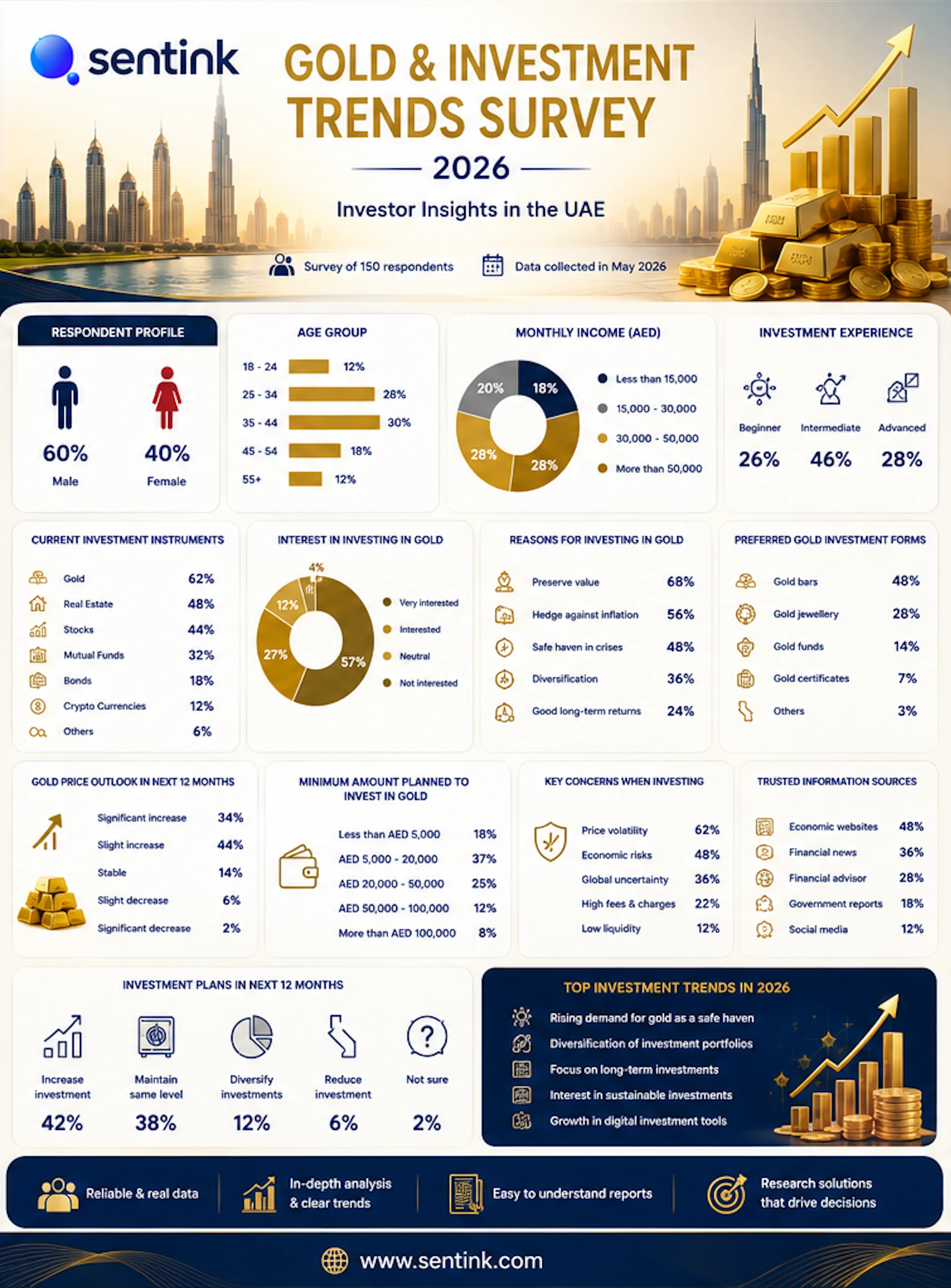
Survey infographic
A visual summary of respondent profiles, key metrics, and top findings from this study.
Frequently asked questions
What are the key findings on gold & investment trends?
Physical gold is now the foundational pillar for regional investment portfolios, not a speculative add-on. Gold's enduring appeal is rooted in legacy and connection, not just financial security. Investors demand growth, but only after their capital is demonstrably secure.
How do the results differ by segment?
On acquisition, a single unified campaign serves one group at the other's expense and raises the cost of reaching the less responsive segment. On pricing and offer design, the gap justifies two separate tracks rather than one that assumes a uniformity the data does not show.
What should leadership do first?
Launch a targeted digital campaign highlighting the role of physical gold as a portfolio stabilizer, leveraging testimonials from existing affluent investors in KSA and UAE. Develop tiered physical gold investment packages that cater to varying capital levels, from entry-level bars to larger, more significant holdings.
How was this research conducted?
113 completed respondents.