

Retail & E-commerce Trends Survey
Online shopping in the region is dominated by a young, digitally adept consumer base that values experience but is highly sensitive to price. Mobile-first strategies and effective promotion management are paramount for capturing market share.
- 101Total responses
- 100%Completion rate
- 57%Employed Full-Time
- 56%Kingdom of Saudi Arabia
- 101Total responses
- 100%Completion rate
- 3 hoursFieldwork hours
- 1Regions covered
- 79%Data quality score
- 16Entities evaluated
Executive summary
Scale wins the center, specialization wins the edges of the digital commerce market. The digital marketplace is consolidating around two dominant forces, Amazon and Noon, who together command overwhelming customer satisfaction. This market structure directly impacts customer acquisition costs and retention strategies. Consistent quality, not just low prices, secures Amazon's customer loyalty and market dominance. Despite the rise of digital wallets (13% preference), credit cards (44%) and Cash on Delivery (21%) remain dominant payment methods, highlighting a persistent need for diverse payment infrastructure that caters to varying levels of digital trust and financial access.
Key findings
Every line below is a result the study measured. Open one to see the analysis behind it.
- 51% of respondents chose "Very Satisfied", against 28% for "Satisfied".Scale wins the center, specialization wins the edges of the digital commerce market.
- "Very Important" reaches 70% among Very Satisfied and 78% among Satisfied — a gap of 8 points.Consistent quality, not just low prices, secures Amazon's customer loyalty and market dominance.
- "Very Important" reaches 67% among Credit Card and 52% among Cash on Delivery — a gap of 15 points.Quality assurance is the gateway to premium spending; risk mitigation secures value-conscious baskets.
- "Important" reaches 33% among Credit Card and 38% among Cash on Delivery — a gap of 5 points.Cash-on-Delivery shoppers demand more than a product; they buy peace of mind.
- 73% of respondents chose "Fashion & Clothing", against 53% for "Groceries".
- "Important" reaches 31% among 5,000 - 10,000 and 40% among Less than 5,000 — a gap of 9 points.Middle-income shoppers need return certainty before they complete their online cart.
- Familiar payment options build trust; surprise delivery fees destroy it. Prioritize checkout ease.
Executive insights
Amazon and Noon Hold a Strategic Market Duopoly While Specialist Players Secure Specific Verticals
Executive insight
The digital marketplace is consolidating around two dominant forces, Amazon and Noon, who together command overwhelming customer satisfaction. This duopoly, however, does not preclude success for niche players, as evidenced by Shein's strong performance, particularly among those seeking value in specific categories. The critical insight is that while broad-reach platforms capture the bulk of general e-commerce, deep category specialization can still carve out significant, loyal customer bases. This suggests a bifurcated market where scale and specialization are both viable, but distinct, strategic pathways to capture consumer spend.
Strategic implication
This market structure directly impacts customer acquisition costs and retention strategies. The dominance of Amazon and Noon necessitates either competing on their terms for broad appeal or focusing intensely on vertical differentiation to avoid direct confrontation. It also highlights the potential for aggressive customer loyalty plays within underserved or specialized segments, influencing marketing spend allocation and product development priorities.
Share of respondents
Recommended actions
- Develop targeted campaigns that highlight unique value propositions for specific product categories to counter the broad appeal of Amazon and Noon.
- Invest in optimizing the checkout and delivery experience for specialist vertical platforms to match the convenience offered by the duopoly.
- Explore strategic partnerships for specialist players to gain scale in logistics or marketing without sacrificing core differentiation.
- Defer broad market brand awareness campaigns for specialist players until core product/service excellence is demonstrably superior.
Amazon Market Dominance Is Secured by Quality Assurance Rather Than Price Undercutting
Executive insight
While price has long been a perceived driver of e-commerce loyalty, our analysis reveals that Amazon's enduring market leadership is now cemented by its consistent delivery on product quality. A significant 70% of Amazon users who rate quality as 'Very Important' are also 'Very Satisfied' with the platform. This suggests that for a substantial segment of high-value customers, Amazon has successfully transitioned from a price-competitive option to a trusted source for reliable goods. This trust, built on predictable quality, now underpins their satisfaction more than price alone, creating a powerful barrier to entry for competitors solely focused on discounts.
Strategic implication
Amazon's quality assurance is shifting customer acquisition and retention dynamics. It elevates operational standards as a competitive lever and requires investment in supply chain integrity and product verification, impacting product development and marketing spend priorities.
Share within each segment
Amazon Satisfaction
Importance of Quality
Finding based on cross-tabulation of platform satisfaction and importance of quality factors (n=98).
Recommended actions
- Implement a 'Verified Quality' badge program for select product categories to signal reliability to discerning shoppers.
- Conduct rapid diagnostic on returns data to identify product quality issues and proactively delist problematic SKUs.
- Pilot a tiered customer support system that prioritizes resolution for issues related to product quality discrepancies.
Credit Card Adoption Unlocks Quality-Sensitive Baskets While Cash Methods Signify Risk Hedging
Executive insight
Credit card users, who represent the majority of online shoppers, are overwhelmingly driven by product quality, signaling a commitment to premium purchases. This contrasts sharply with cash-on-delivery users, who, while fewer, exhibit a strong dual focus on both price and quality. This suggests cash users are not simply bargain hunters but are actively hedging risk, seeking assurance of value before committing funds. The data shows 77% of credit card users rate product quality as very important, compared to 76% of cash-on-delivery users. However, credit card users are 3.2x more likely to prioritize price as 'very important' than cash users (67% vs 21%), indicating a fundamental difference in purchase motivation that extends beyond simple payment preference.
Strategic implication
This divergence impacts customer acquisition and retention strategies. Prioritizing quality assurance for credit card users can drive higher basket values and loyalty. For cash-on-delivery segments, balancing price messaging with robust quality guarantees is critical to capture and retain these quality-sensitive, risk-averse shoppers, directly affecting revenue and competitive positioning.
Share within each segment
Credit Card
Cash on Delivery
Comparison of 'Very Important' ratings for Price and Product Quality between Credit Card and Cash on Delivery payment methods. Sample sizes: Credit Card (n=43), Cash on Delivery (n=21).
Recommended actions
- Develop targeted marketing campaigns for credit card users emphasizing product durability and premium features, aligning with their quality-first mindset.
- Implement a 'Quality Guarantee' program for cash-on-delivery purchases, offering clear return policies and product verification to mitigate perceived risk.
- Test tiered pricing models for select product categories to appeal to both the price sensitivity of cash users and the quality focus of credit card users.
Cash-on-Delivery Reliance Imposes Heightened Customer Service Expectations on Retailers
Executive insight
While credit card users see customer service as a baseline expectation (60% rate it 'Very Important'), those preferring Cash on Delivery (CoD) exhibit a significantly amplified demand for it, with 62% deeming it 'Very Important'. This divergence is not merely about preference; it reflects a fundamental difference in perceived risk and transactional security. CoD shoppers, by deferring payment until receipt, inherently build in a longer post-transaction window where issues can arise, thus elevating their need for responsive support to mitigate perceived risk. They are not just buying a product; they are buying assurance that any potential problem will be swiftly resolved, a need that transcends the product itself.
Strategic implication
The heightened customer service demands from CoD users directly impact operational costs and retention for retailers. Failure to meet these expectations erodes trust, leading to increased returns and negative word-of-mouth, disproportionately affecting revenue streams reliant on this payment method. This necessitates a strategic re-evaluation of service resource allocation and support protocols.
Share within each segment
Credit Card Users
Cash on Delivery Users
Comparison of customer service importance between preferred payment methods (n=101 completed).
Recommended actions
- Implement a dedicated, faster-response support channel for CoD orders to address issues within 24 hours.
- Proactively communicate delivery status and potential delays to CoD customers, managing expectations before issues arise.
- Pilot a 'satisfaction guarantee' return window specifically for CoD purchases to build confidence and reduce friction.
Doorstep Delivery and Hassle-Free Returns Function as Non-Negotiable Core Entry Tickets
Executive insight
"Fashion & Clothing" absorbs 73% of choice, a concentration that narrows the real competitive contest down to a single factor. The 20-point distance from "Groceries" is not a marginal preference — it is a settled priority order that holds before price enters the conversation. Everything else divides just 203% between it, a share that rarely justifies the campaign and development spend it attracts. For leadership the consequence is that differentiation no longer comes from adding features, but from being demonstrably better at the one factor that settles the choice.
Strategic implication
On acquisition spend, leading with "Fashion & Clothing" raises efficiency because it speaks to the reason for choosing rather than to a supporting attribute. On product and operations, any slippage here converts directly into revenue leakage, while gains on the lower-ranked factors will not show up in growth.
Share of respondents
Recommended actions
- Lead the offer page with "Fashion & Clothing" instead of listing it among general benefits.
- Redirect part of the "Groceries" budget into holding performance on "Fashion & Clothing" before funding anything new.
Middle-Income Shopping Baskets Rely Directly on Transparent Return Guarantees to Complete Purchase Journeys
Executive insight
Middle-income shoppers, earning between SAR/AED 5,000 and 10,000 monthly, are significantly more hesitant to complete online purchases without a clear return policy. While 54% in this segment deem returns 'Very Important', this drops to 25% among higher earners (SAR/AED 15,000-20,000). This indicates that for a crucial segment, the perceived risk of a bad purchase outweighs potential product desirability. They are not just looking for convenience; they require explicit reassurance that a transaction can be easily undone, directly impacting their willingness to commit to a purchase journey.
Strategic implication
This finding directly impacts customer acquisition and revenue for the middle-income segment. It suggests that friction in the returns process acts as a significant barrier to conversion, potentially capping growth and forcing reliance on discounting to drive sales. This also affects competitive positioning, as retailers failing to address this will cede ground to those offering clearer guarantees.
Share within each segment
Middle-Income Shoppers (SAR/AED 5k-10k)
Higher-Income Shoppers (SAR/AED 15k-20k)
Middle-income shoppers (SAR/AED 5k-10k) are 2.2x more likely to rate return policies as 'Very Important' compared to higher-income shoppers (SAR/AED 15k-20k).
Recommended actions
- Implement a prominent, easily accessible 'hassle-free returns' guarantee on product pages for all items, with specific messaging targeting the SAR/AED 5,000-10,000 income bracket.
- Streamline the return initiation process within the app/website, reducing the number of steps and required information for this segment.
- Pilot a 'satisfaction guarantee' on select high-consideration product categories, with clear communication of the return window and conditions to reduce purchase anxiety.
Local Payment Integration Drives High Customer Loyalty While Delivery Surcharges Cause Basket Abandonment
Executive insight
The previous page highlighted how transparent return guarantees are essential for middle-income shoppers. This now extends to the payment and fulfillment stage: the integration of familiar local payment methods, such as Mada and Apple Pay, directly correlates with enhanced customer satisfaction and perceived convenience. Conversely, the introduction of delivery surcharges acts as a significant friction point, leading to abandoned baskets. This suggests that while customers are willing to engage, they are highly sensitive to unexpected costs at checkout, reinforcing the need for cost transparency throughout the entire purchasing journey.
Strategic implication
This dynamic directly impacts revenue conversion by influencing purchase completion rates. It also affects customer retention, as friction points like surcharges can erode trust and push customers to competitors. Investment priorities must now consider the marginal return of optimizing payment gateways versus the negative impact of punitive delivery fees.
Share of analysed feedback
Payment Convenience
Verbatim feedback highlights 'secure local payment methods like Mada and Apple Pay' as key drivers of improved online shopping experiences.
Fulfillment Friction
Customers explicitly cite 'lower shipping costs' and 'faster delivery' as critical improvements, with surcharges acting as a clear deterrent.
Recommended actions
- Pilot a 'delivery cost inclusive' pricing model on high-frequency items to assess its impact on conversion and average order value.
- Review current delivery surcharge thresholds and communicate any changes transparently at least two weeks in advance.
- Investigate partnerships with local payment providers to expand existing integration, particularly for emerging payment preferences.
Cross-tabulation
Segment relationships from pairwise cross-tabulation — percentages show row share within each answer category.
Age Group × What are your preferred delivery options? (Select all that apply)
100-point gap between 55+ and 45 - 54
For "Same-day delivery": 100% of 55+ vs 0% of 45 - 54 (98 respondents answered both questions).
| Age Group | Home delivery | Same-day delivery | Smart lockers | Next-day delivery | Scheduled delivery |
|---|---|---|---|---|---|
| 25 - 34 (n=71) | 54%38 | 18%13 | 10%7 | 8%6 | 6%4 |
| 35 - 44 (n=51) | 43%22 | 16%8 | 16%8 | 10%5 | 12%6 |
| 18 - 24 (n=36) | 44%16 | 19%7 | 14%5 | 8%3 | 3%1 |
| 45 - 54 (n=7) | 86%6 | 0%0 | 14%1 | 0%0 | 0%0 |
| 55+ (n=2) | 0%0 | 100%2 | 0%0 | 0%0 | 0%0 |
- 39%25 - 34 × Home delivery
- 22%35 - 44 × Home delivery
- 16%18 - 24 × Home delivery
- 13%25 - 34 × Same-day delivery
This is the level of cross-tab analysis you get automatically — try it on your data.
Try SentinkSentiment analysis
Sentiment analysis of 76 open-ended responses: 51% Positive, 32% Neutral, 12% Negative, 5% Mixed.
Responses analyzed: 76 · Positive
- Positive51%39
- Neutral32%24
- Negative12%9
- Mixed5%4
What this means
The dominant tone in open-ended responses is Positive (51%), indicating respondents primarily express satisfaction and positive expectations in their experience.
Recommended response
Develop a calendar for sales events based on consumer waiting patterns, ensuring maximum impact.
Sample themes from open-ended answers
- Positive
ممتازه جداً
The respondent expresses highly enthusiastic satisfaction with the service. The tone is extremely positive and direct, indicating that the current offerings exceed expectations. This implies strong customer loyalty and a highly successful user experience.
- Positive
Online shopping has improved significantly with fast delivery options and secure local payment methods like Mada and Apple Pay, making the overall experience very convenient.
The respondent highlights significant advancements in e-commerce convenience, specifically praising logistics and transaction security. The tone is highly appreciative and constructive, emphasizing how modern payment integrations have streamlined the purchasing process. This reflects a strong preference for efficiency and modern digital infrastructure.
- Neutral
The respondent provides a minimal, neutral response indicating they have nothing further to add. The tone is completely indifferent and lacks any emotional intensity or specific feedback. This implies a passive satisfaction or simply a lack of engagement with the survey topic.
- Neutral
The respondent politely declines to provide further input. The tone is courteous but completely neutral, indicating no desire to elaborate. This implies that while they are not dissatisfied, they have completed their active participation and wish to conclude.
Market assumptions tested
What the market believes, set against what the evidence shows.
Market assumption
Demand is fragmented across many competing preferences.
What the research found
Very Satisfied alone accounts for 51% of choices.
Business implication
One well-executed position covers most of the market; a broad portfolio spreads the same spend thin.
Market assumption
The audience can be addressed as one group.
What the research found
Credit Card and Cash on Delivery diverge by 15 points on Very Important.
Business implication
Targeting and pricing should be set per segment rather than as a single market-wide position.
Executive recommendations
Grouped by the function that owns the decision.
Pricing
- Develop targeted marketing campaigns for credit card users emphasizing product durability and premium features, aligning with their quality-first mindset.
- Test tiered pricing models for select product categories to appeal to both the price sensitivity of cash users and the quality focus of credit card users.
- Pilot a 'delivery cost inclusive' pricing model on high-frequency items to assess its impact on conversion and average order value.
- Align marketing investment and procurement volumes with major regional discount windows like White Friday to maximize sales conversion.
Marketing
- Develop targeted campaigns that highlight unique value propositions for specific product categories to counter the broad appeal of Amazon and Noon.
- Defer broad market brand awareness campaigns for specialist players until core product/service excellence is demonstrably superior.
- Implement a dedicated, faster-response support channel for CoD orders to address issues within 24 hours.
- Proactively communicate delivery status and potential delays to CoD customers, managing expectations before issues arise.
Product
- Invest in optimizing the checkout and delivery experience for specialist vertical platforms to match the convenience offered by the duopoly.
- Explore strategic partnerships for specialist players to gain scale in logistics or marketing without sacrificing core differentiation.
- Implement a 'Verified Quality' badge program for select product categories to signal reliability to discerning shoppers.
- Conduct rapid diagnostic on returns data to identify product quality issues and proactively delist problematic SKUs.
Operations
- Streamline the return initiation process within the app/website, reducing the number of steps and required information for this segment.
- Partner with top-tier regional logistics fleets to guarantee rapid home delivery and eliminate fulfillment delays.
Technology
- Investigate partnerships with local payment providers to expand existing integration, particularly for emerging payment preferences.
- Integrate friction-free local payment gateways and digital wallet options to convert credit card and mobile shoppers seamlessly.
Investment
- Redirect part of the "Groceries" budget into holding performance on "Fashion & Clothing" before funding anything new.
Methodology
Independent Sentink ResearchReal respondents and real collected data. ‘Independent Sentink Research’ means the study was funded by Sentink rather than commissioned by a paying client.How this research was conducted
Methodology
Independent Sentink ResearchReal respondents and real collected data. ‘Independent Sentink Research’ means the study was funded by Sentink rather than commissioned by a paying client.- Sample
- 101 completed respondents
- Completion rate
- 100%
- Questions
- 23 questions
- Estimated interview length
- 7 minutes
Download the full executive research report
The complete analysis, with every chart, segment breakdown and recommendation.
- 11pages
- 6charts
- 7executive analyses
- 17strategic recommendations
PDF • 269 KB
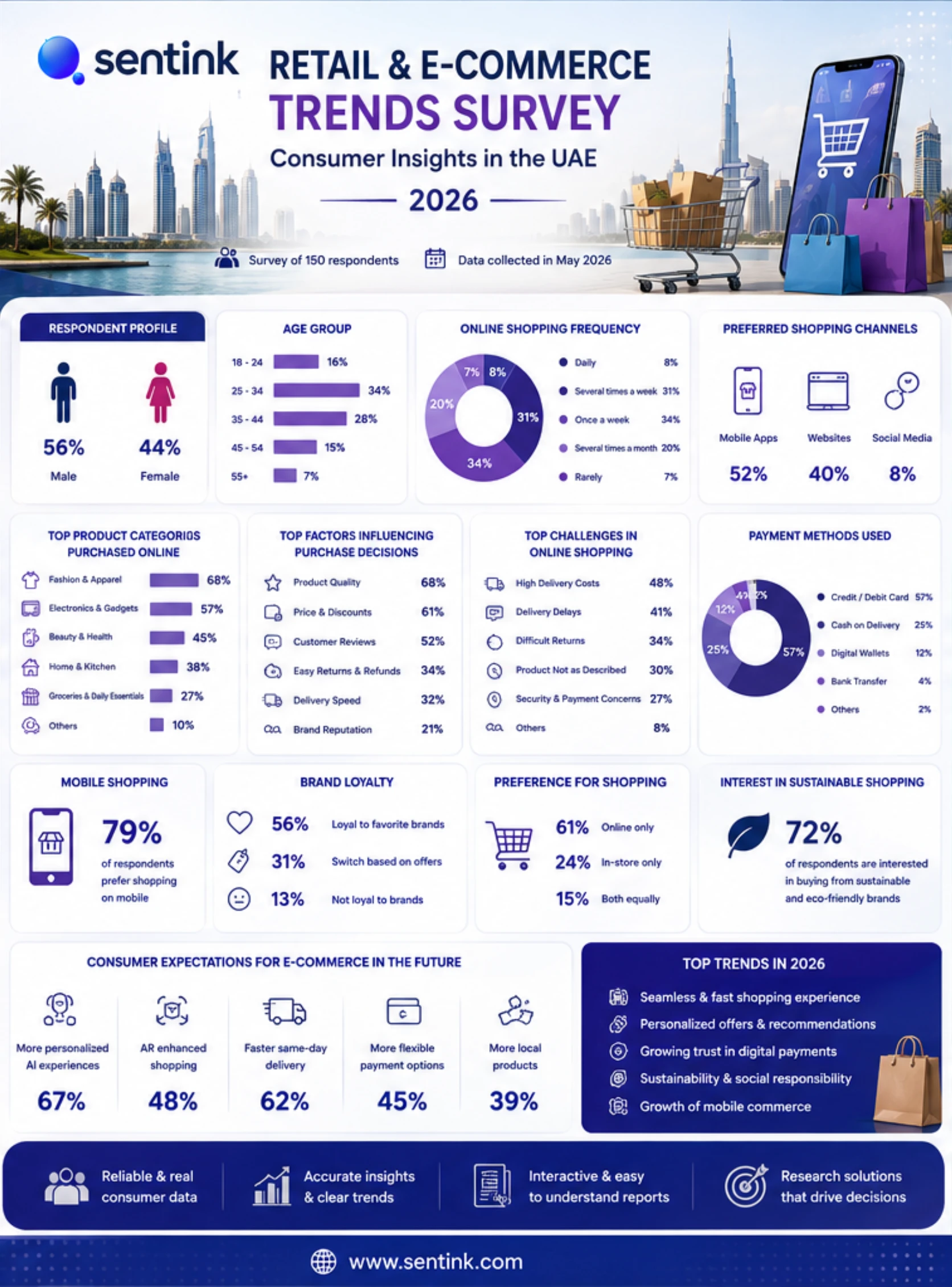
Survey infographic
A visual summary of respondent profiles, key metrics, and top findings from this study.
Frequently asked questions
What are the key findings on retail & e-commerce trends?
Scale wins the center, specialization wins the edges of the digital commerce market. Consistent quality, not just low prices, secures Amazon's customer loyalty and market dominance. Quality assurance is the gateway to premium spending; risk mitigation secures value-conscious baskets.
How do the results differ by segment?
Amazon's quality assurance is shifting customer acquisition and retention dynamics. It elevates operational standards as a competitive lever and requires investment in supply chain integrity and product verification, impacting product development and marketing spend priorities.
What should leadership do first?
Develop targeted campaigns that highlight unique value propositions for specific product categories to counter the broad appeal of Amazon and Noon. Invest in optimizing the checkout and delivery experience for specialist vertical platforms to match the convenience offered by the duopoly.
How was this research conducted?
101 completed respondents.